Paintings .com
Collection





on Google Maps









| Phone Voicemail text 707-875-2911 | Now at the Gallery | email us | ||||||
| Linda Sorensen Paintings .com |
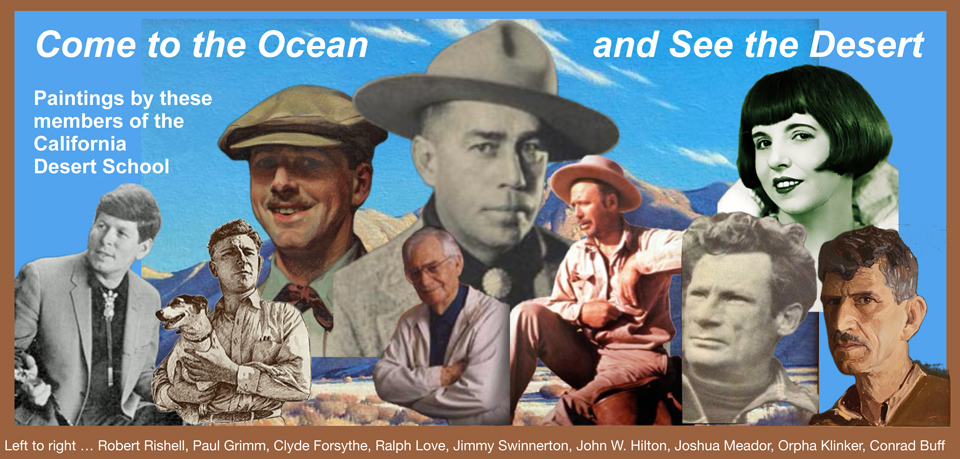
Joshua Meador Collection |
|
|
|
|
|
view us on Google Maps |
|
|
|
|
|
|
|
|
|
|
| May 2026 Newsletter |
|
 |
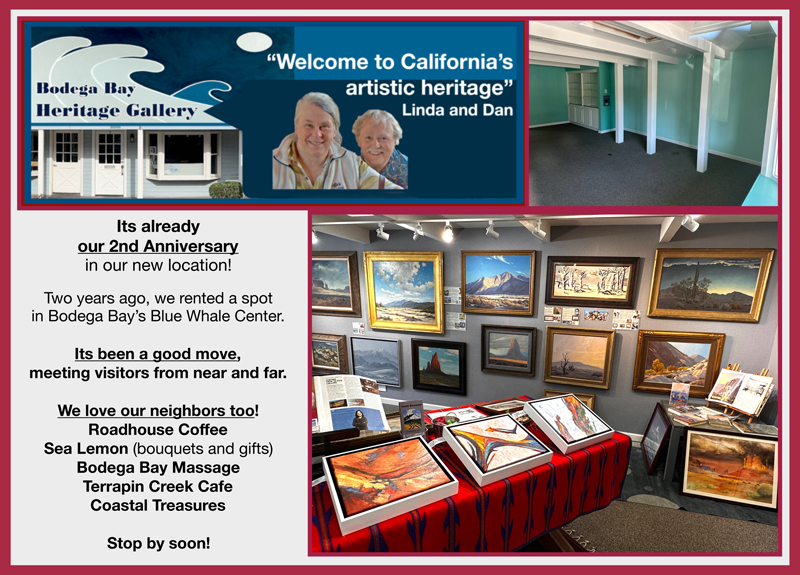
Bodega Bay Heritage Gallery 1580 Eastshore Road Thursday - Sunday, 11 am - 6 pm (next door to the Terrapin Creek Cafe) |
|
||
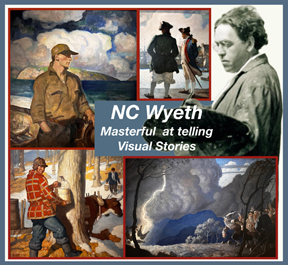 N.C. Wyeth, Master at telling Visual Stories |
|
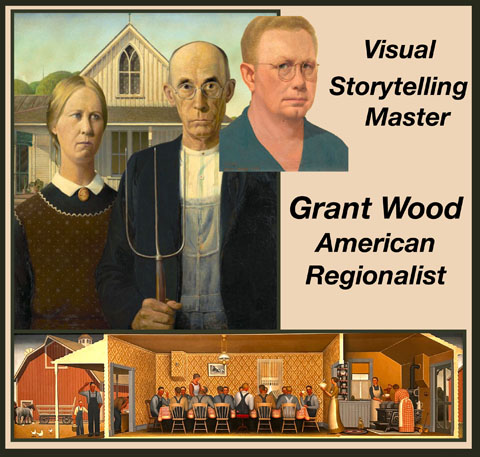
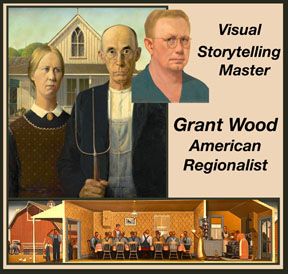 Visual Storytelling Master Grant Wood |
|
||
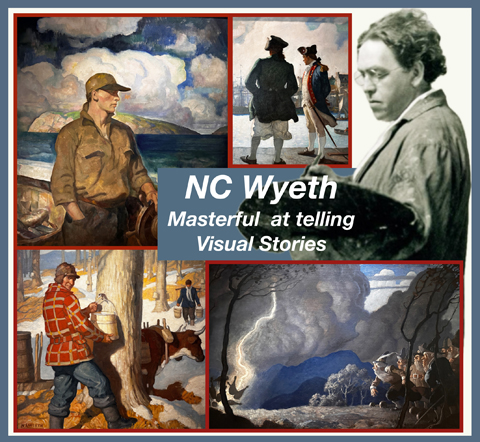 |
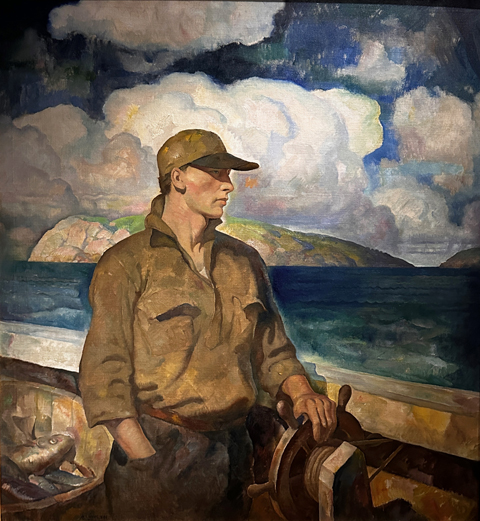
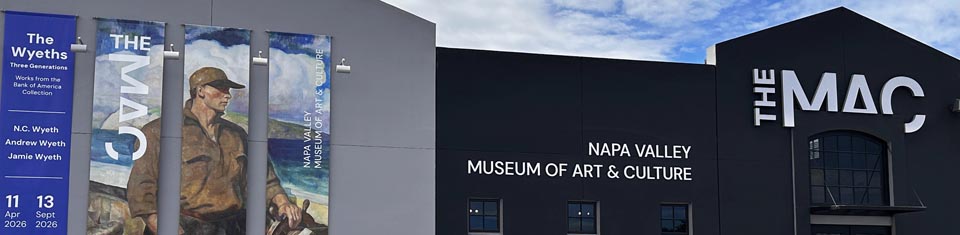
N. C. Wyeth Masterful at Telling Visual Stories now part of MUSEUM EXHIBIT The Wyeths: Three Generations of Iconic American Artists at the Napa Valley Museum of Arts and Culture (MAC) in St. Helena ... through Sept 13 |
|
|
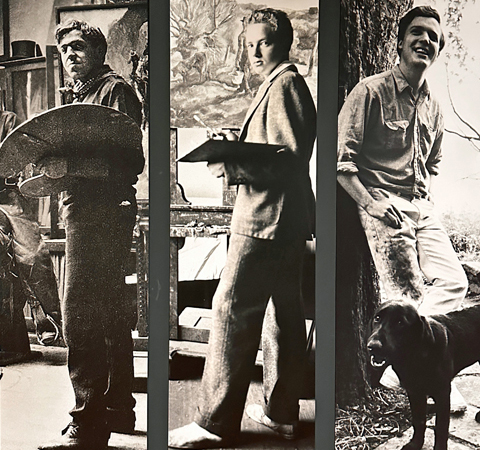 Newell Convers (N.C. ) Wyeth 1882-1945 (left) Andrew Wyeth 1917-2009 (center) Jamie Wyeth 1946- (right) |
|
| from our February 2018 issue | ||
| In January, 2018, Linda and I made an ambitious one day trip (up-and-back) to the Seattle Museum of Art to see the Andrew Wyeth Retrospective (see our Feb 2018 issue) |
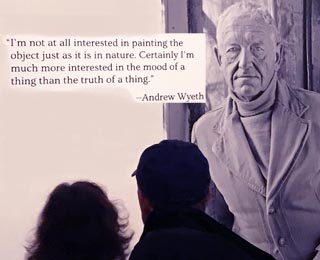 Feb '18, A vist to the Seattle Art Museum, Andrew Wyeth in Retrospect |
|
 |
||
|
||
| Paintings by N. C. Wyeth | ||
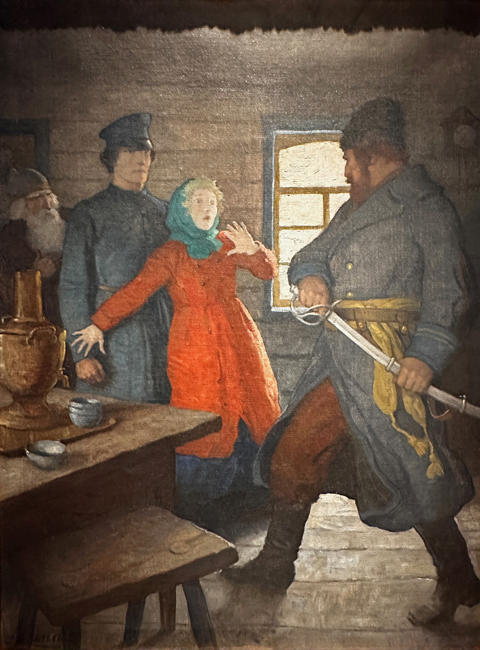 N.C. Wyeth, "Defend Yourself, for I shall not spare you!" 1927 illustration for Jules Verne's Michael Strogoff, 1876 |
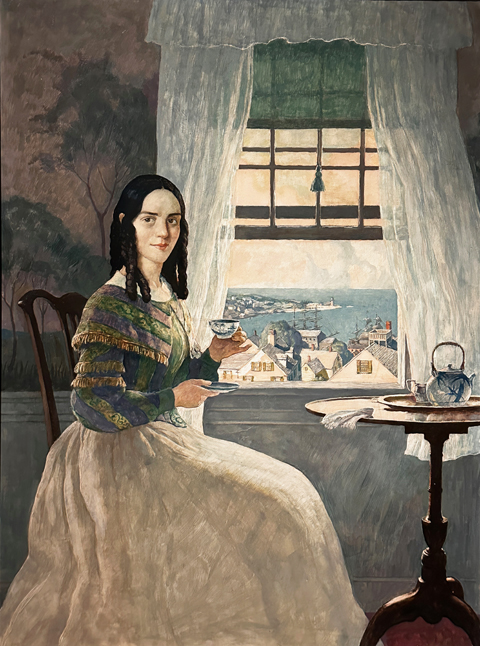 N.C. Wyeth, Portrait of Jane Nason Tibbets, 1937 aka A Maine Sea Captain's Daughter, set in 1850 In this case, this painting is a standalone fine-art painting, not tied to a published narrative. |
|
Defend Yourself is a vivid, narrative-driven illustration capturing a moment of high tension. Though the literary source is unknown, Wyeth focuses on the instant before violence erupts—much like Alfred Hitchcock’s mastery of suspense. |
|
|
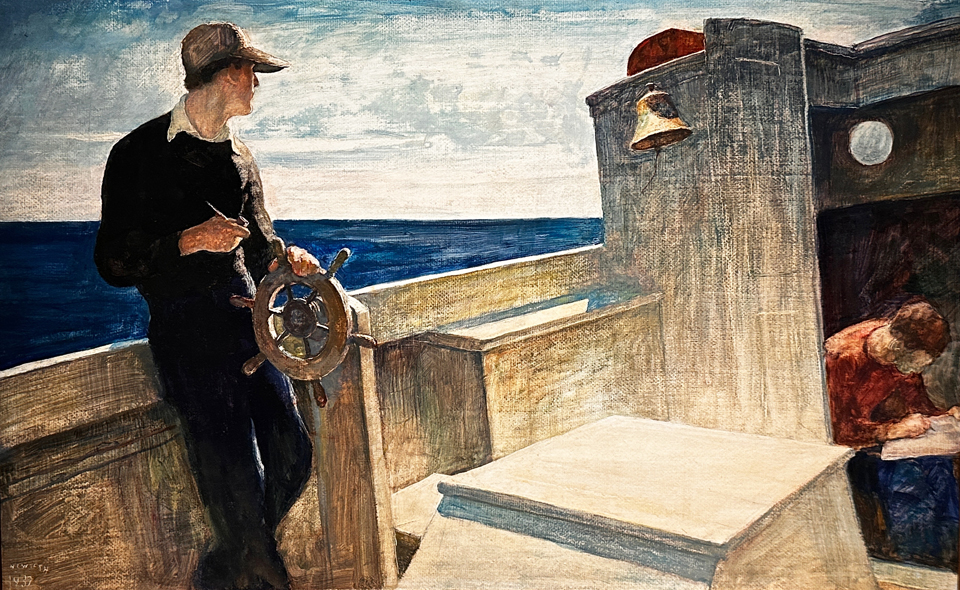 N.C.Wyeth, Eight Bells, 1937 |
||
Eight Bells is a peaceful maritime scene featuring Wyeth’s son Andrew and his friend Clyde Stanley. Referencing Winslow Homer’s painting of the same name, Wyeth captures stillness at sea. The theme resonated so deeply with him that he later named his Maine home “Eight Bells.” |
||
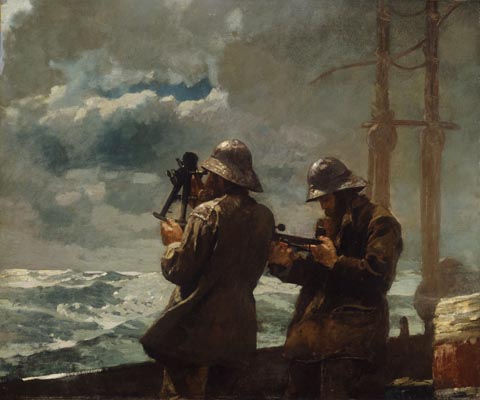 Winslow Homer, Eight Bells, 1886 Addison Gallery of American Art, Andover, Massachusetts (this painting is not part of the exhibition) |
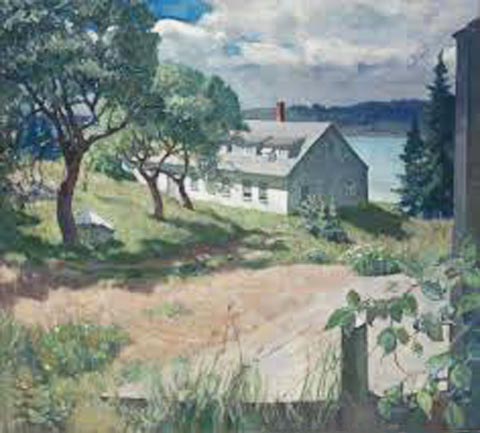 N. C. Wyeth, Eight Bells , 1932. Wyeth's home in Port Clyde, Maine, Brandywine Museum, Chadds Ford, PA (this painting is not part of the exhibition) |
|
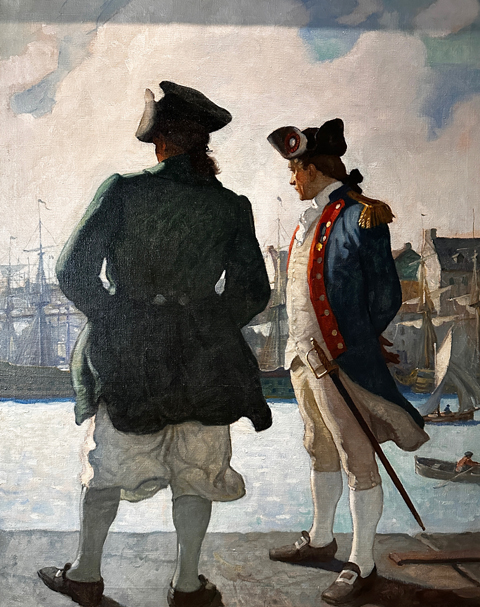 N.C. Wyeth, On the Sea Wall with John Paul Jones, 1928 |
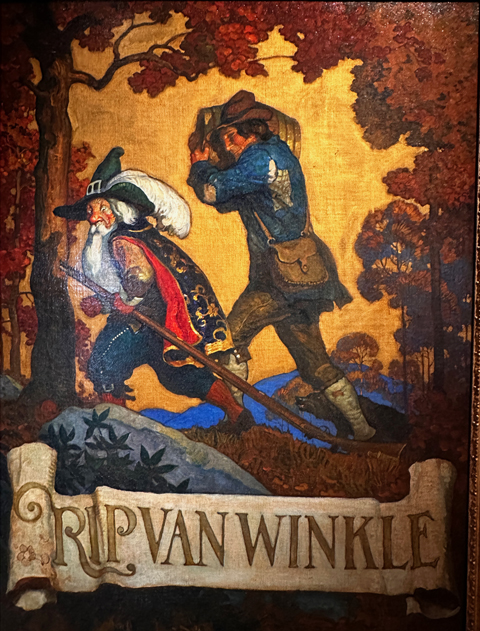 N.C. Wyeth, Rip Van Winkle, cover illlustration, 1921 (the figure with plumed hat and cape seems to invite you to follow him into the story) |
|
Depicting a young John Paul Jones, this work reflects Wyeth’s training under Howard Pyle. Wyeth blends a historical subject with theatrical staging, as John Paul Jones gazes outward, poised not only on the edge of the sea wall, but on the edge of destiny. |
Rip Van Winkle is N.C. Wyeth's cover for an illustrated edition of Washington Irving's story. The archaic Dutch-looking man with plumed hat and cape is one of the ghostly bowlers, followed by a bewildered Rip Van Winkle, a moment in the story when Rip encounters mysterious figures who lead him into his enchanted twenty-year-long sleep. |
|
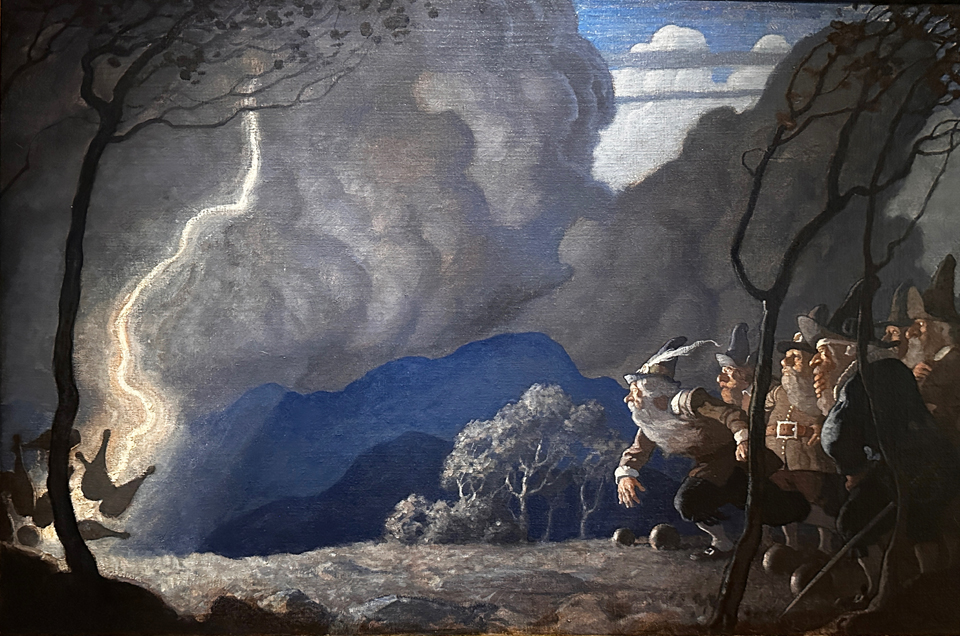 N.C. Wyeth, Rip Van Winkle endpaper illustration, 1921, (A group of gnomes bowl with lightening bolts streaking across the sky as the ball strikes the pins.) |
||
Rip Van Winkle's endpaper illustration is one of several illustrations included within the book. This scene shows an eerie supernatural moment with archaic Dutch figures bowling (Ninepins) in the forest. This occurred moments before Rip Van Winkle falls into his twenty-year-long nap. Massive clouds dominate the scene with a jagged bolt of lightning splitting the sky. |
||
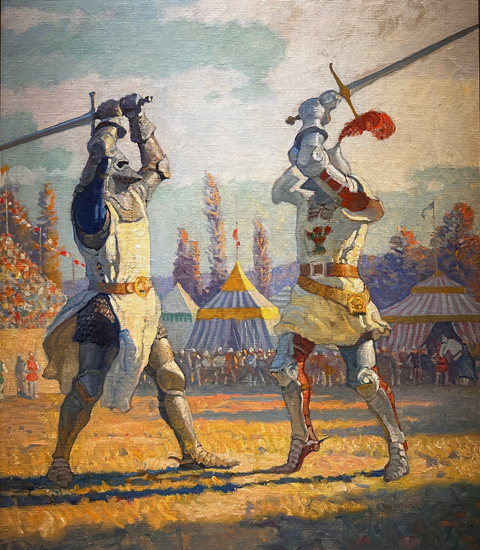 N.C. Wyeth, Sir Nigel Sustains England's Honor, 1922 |
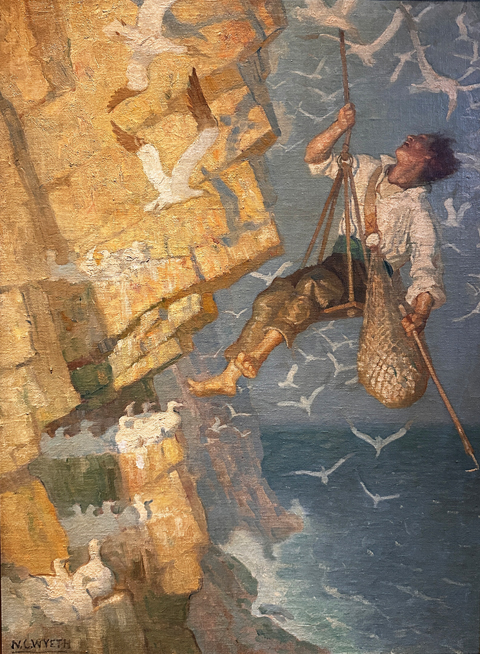 N.C. Wyeth, Tam on the Craig Face, 1924 for Robert Louis Stevensen's David Balfour, 1893, a sequel of Kidnapped. |
|
Sir Nigel Sustains England's Honor shows medieval chivalry and combat inspired by Arthur Conan Doyle’s Tales of the Hundred Years’ War. Wyeth condenses heroism, motion, and drama into a single charged moment, complete with horses, armor and swinging swords. |
|
|
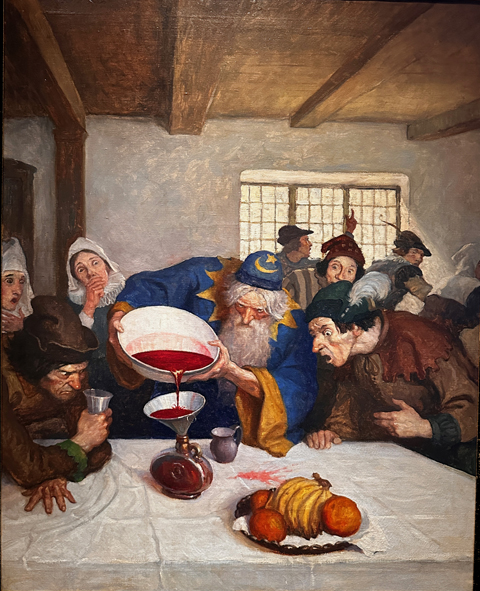 N.C. Wyeth, "The Astrologer emptied the whole of the bowl into the bottle," 1916. |
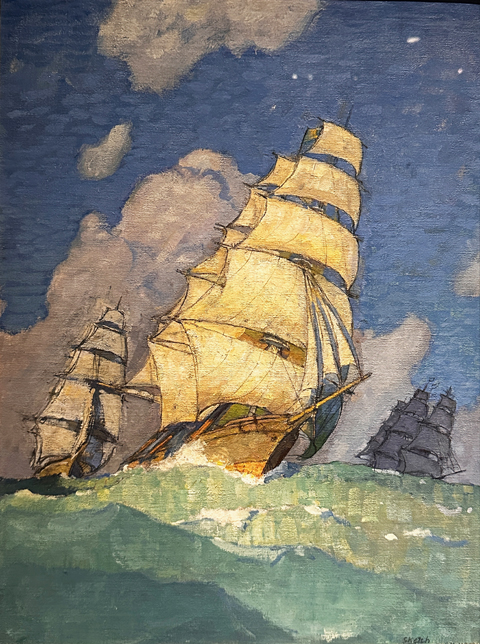 N.C. Wyeth, The Clippers, 1923 |
|
|
The Clippers shows fully rigged ships surge forward with power and purpose. Wyeth portrays them as symbols of 19th-century ambition, embodying freedom, strength, and risk. |
|
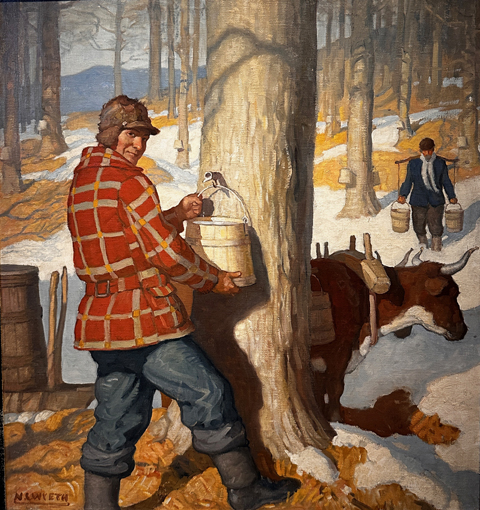 N.C. Wyeth, The Country Gentleman, 1926 cover illustration for Tapping Sugar Maples |
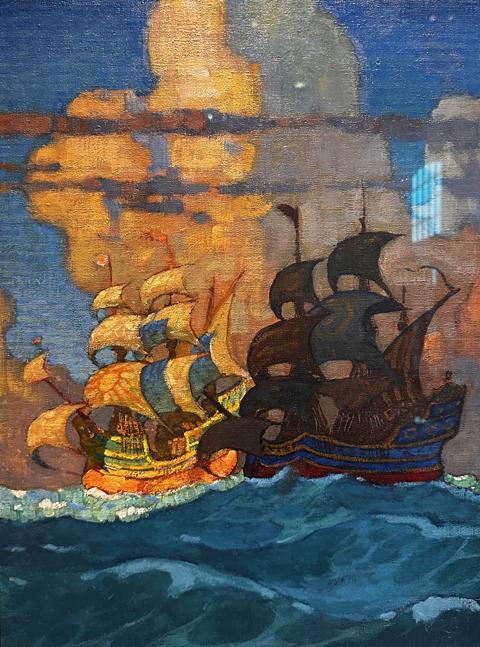 N.C. Wyeth, The Elizabethan galleons, 1923 |
|
The Country Gentleman (magazine cover) shows a common New England late-winter farm scene: a farmer taps maple trees while oxen wait nearby. Wyeth elevates this late winter labor scene into a story of endurance, cooperation, and quiet heroism. |
Elizabethan Galleons captures towering tall masted ships with billowing sails cutting through wind and sea in a theatrical display of motion and light. Wyeth transforms history into lived drama—full of exploration and danger. |
|
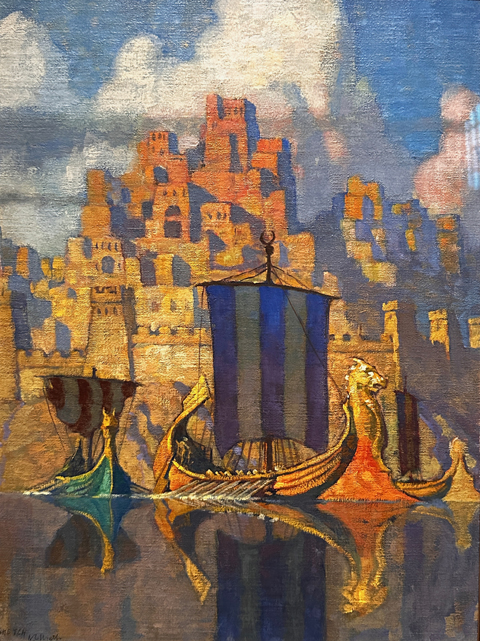 N.C. Wyeth, The Phoenician Biremes, 1923 |
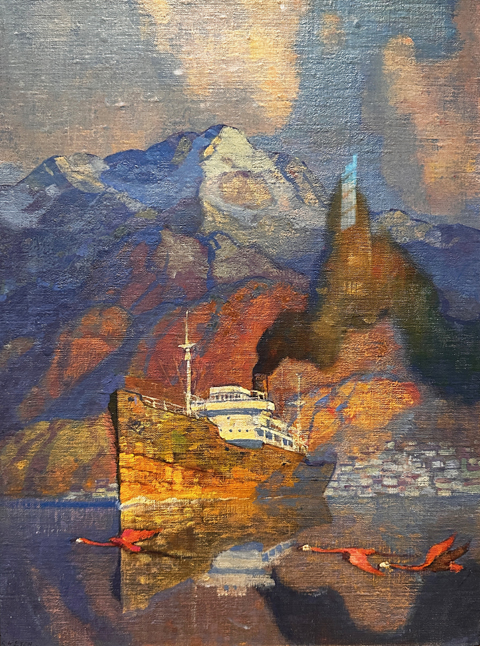 N.C. Wyeth, The Tramp Steamer, 1923 |
|
The Phoenician Biremes tells the same story as he does in Elizabethan Galleons, but occurring a thousand years earllier. The Phoenicians with their oar-driven ships suggest an exotic world just beginning to explore its limits. Together, the two works act as historical bookends. |
|
|
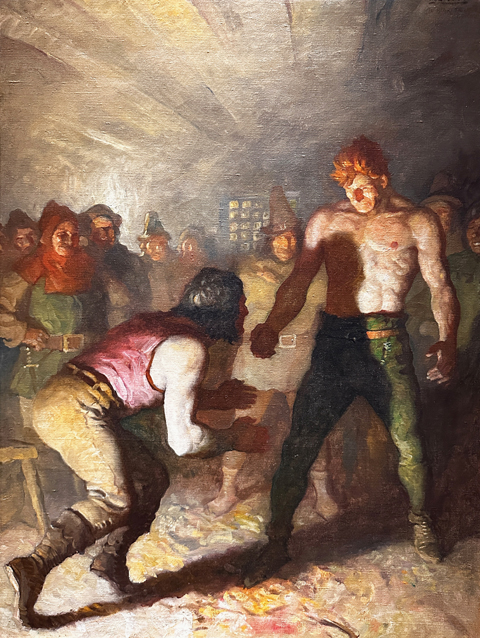 N.C. Wyeth, The Wrestling Match at the Pied Merlin, 1922 "It would have been hard that night, through the whole length of England, to set up a finer pair in the face of each other." |
The Wrestling Match at the Pied Merlin takes place inside a medieval tavern. In this scene, tension builds before the match begins. Wyeth focuses not on the fight, but on anticipation, the charged moment before action. |
|
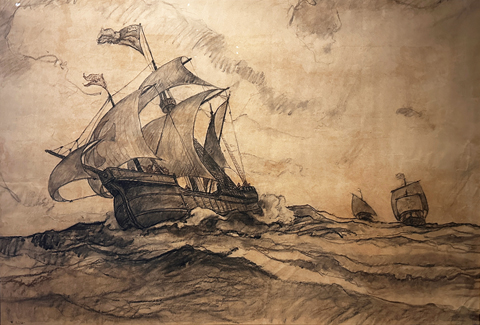 N.C. Wyeth A New World View, The Three Vessels of Columbus, 1942, Charcoal and graphite on paper. |
||
The Three Vessels of Columbus makes it clear that the story isn’t about arrival, it’s about the journey. The Niña, Pinta, and Santa María press into the unknown. Wyeth emphasizes motion and risk. |
||
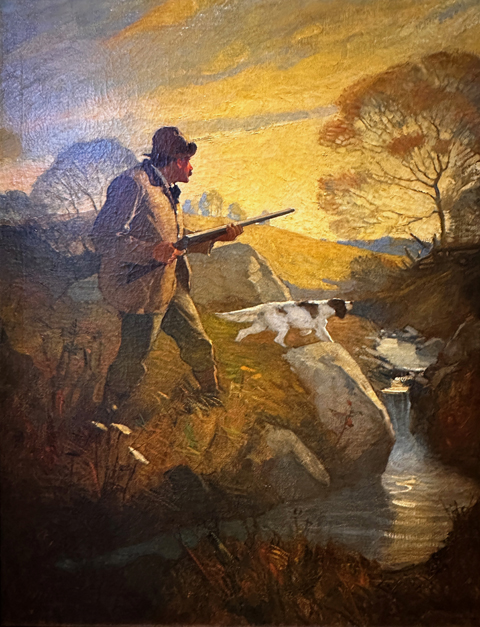 N.C. Wyeth, untitled, Hunter and Dog beside Stream, c1912-13 |
Hunter and Dog beside Stream An early work capturing poised stillness. Hunter and dog wait, alert, anticipating action just beyond the frame. Wyeth's focus wasn't in what happened, but what was about to happen. |
|
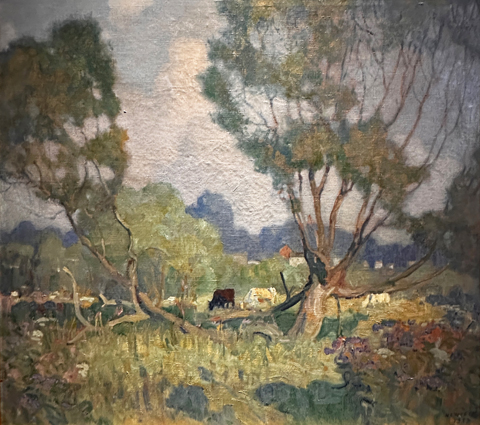 N.C. Wyeth, untitled landscape, 1923 |
||
|
||
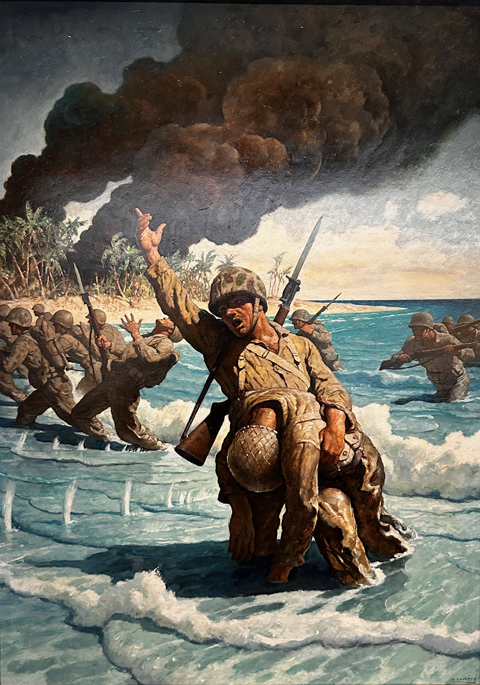 N.C. Wyeth, untitled, Marines landing on a South Pacific beach, 1944 |
|
|
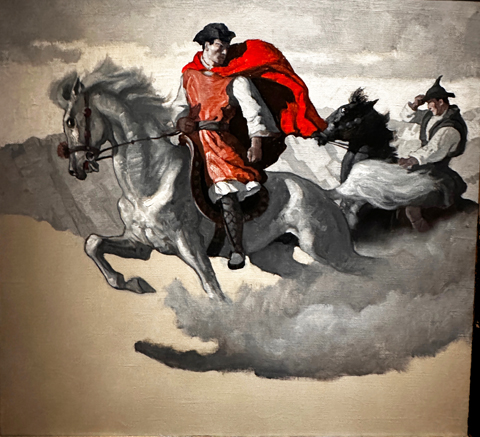 N.C. Wyeth, Riding Furiously, 1923 "We rode quietly until the suburbs had dropped behind, and then lashed out furiously." |
||
|
|
|
| The Napa Valley Museum of Art and Culture: The Wyeths, Three Generations | | ||
| Dinner for Threshers, 1934 Grant Wood, 1891-1942 One of my favorites from the de Young's Permanent Collection |
 |
|
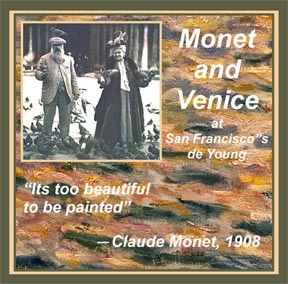
In late March, Linda and I attended the Monet and Venice exhibition at the de Young Museum in San Francisco. After viewing the exhibition, we strolled through galleries featuring some of the de Young's marvelous permanent collection. |
||
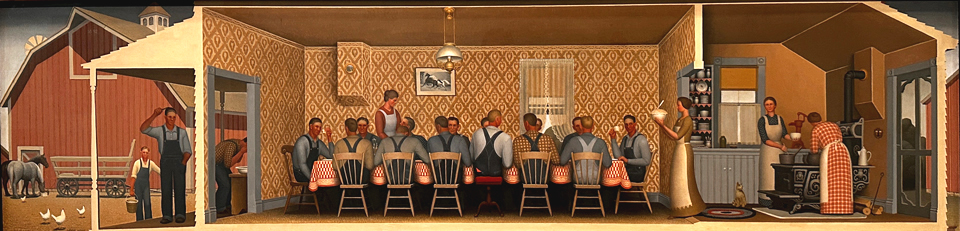 Grant Wood, Dinner for Threshers 1934, Fine Art Museums San Francisco |
||
| About Grant Wood | ||
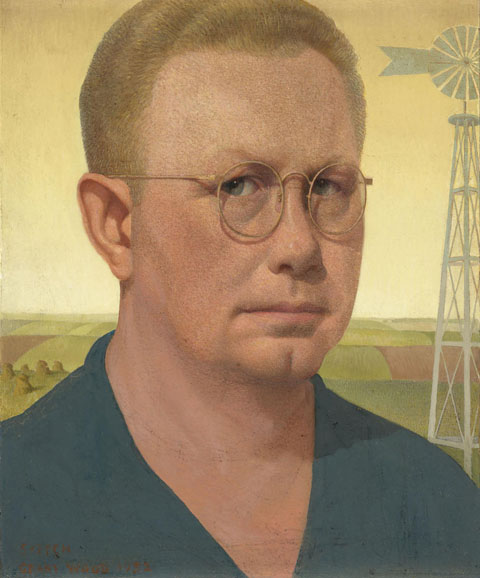 Grant Wood, Self Portrait 1932, Figge Art Museum, Davenport, IA |
|
|
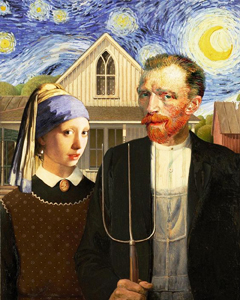
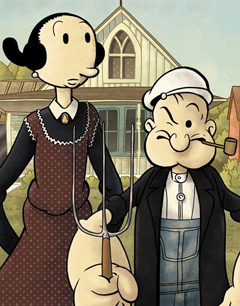
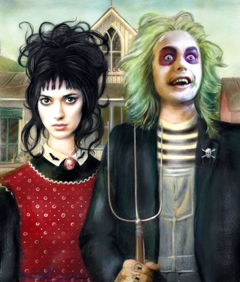
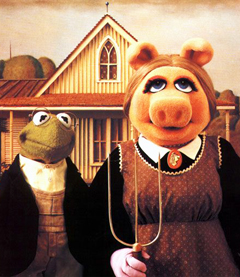
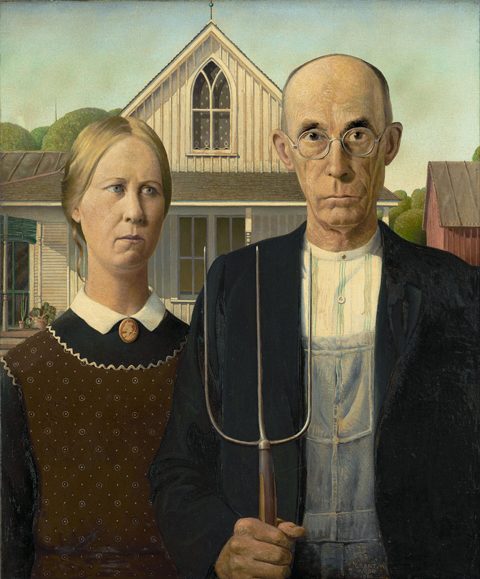 Grant Wood, American Gothic, 1930, Art Institute of Chicago |
 |
 |
 |
 |
|
Grant Wood's American Gothic is his most famous painting. In an understated manner, it captures Americans' resolve and dignity while they were enduring the challenges of the Great Depression. As the painting gained in fame, it has been the source of countless parodies. |
||
Wood's lesser known but equally impactful paintings capture a stylized vision of 1930's America. |
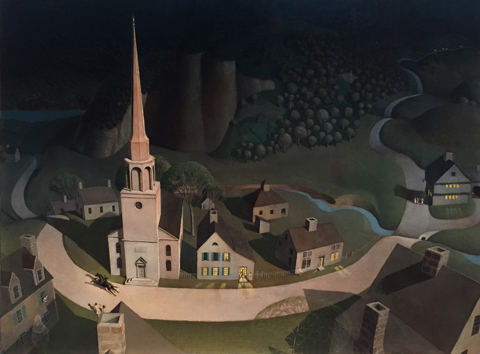 Grant Wood, Midnight Ride of Paul Revere, 1931 Metropolitan Museum, NYC |
|
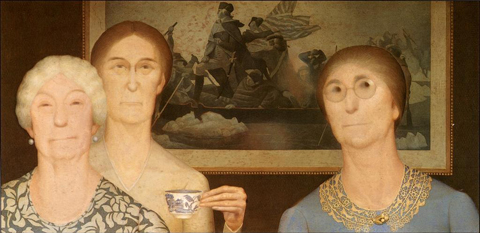 Grant Wood, Daughters of Revolution, 1932, Cincinnati Art Museum |
||
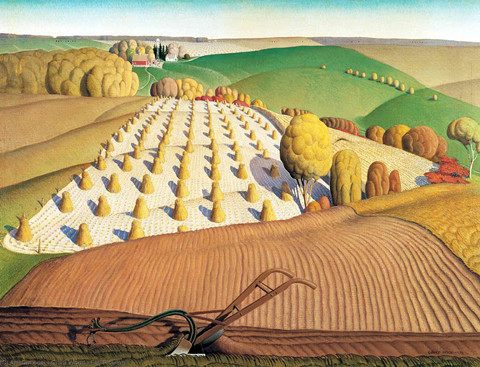 Grant Wood, Fall Plowing, 1931, John Deere Collection |
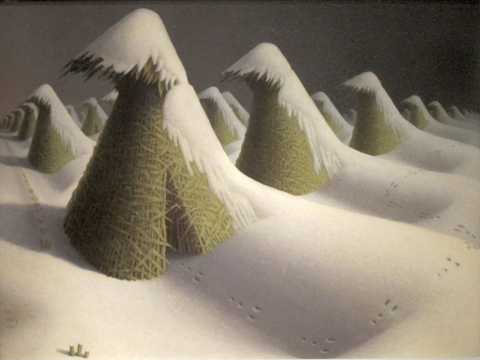 Grant Wood, January, 1940, Cleveland Museum of Art |
|
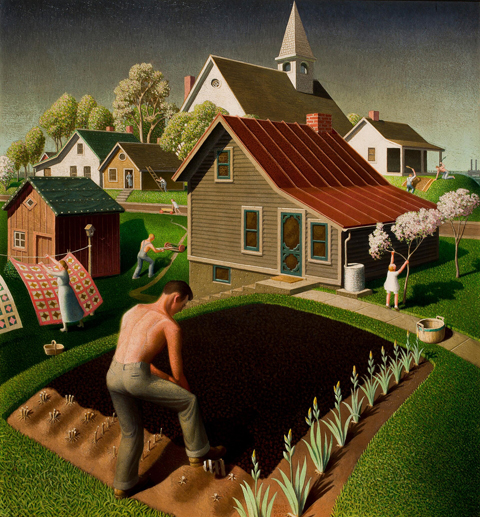 Grant Wood, Spring in Town, 1941 Swope Museum, Terre Haute, IN |
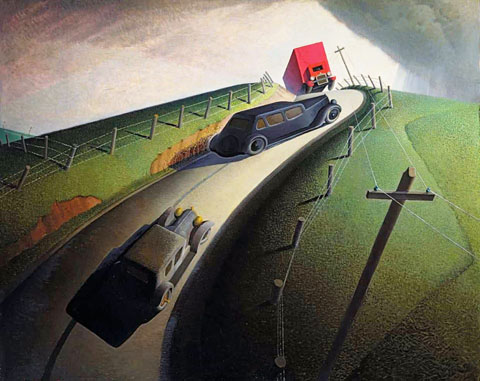 Grant Wood, Death on Ridge Road, 1935 Williams College Museum of Art, Williamstown, MA |
|
| Dinner for Threshers, 1934 | ||
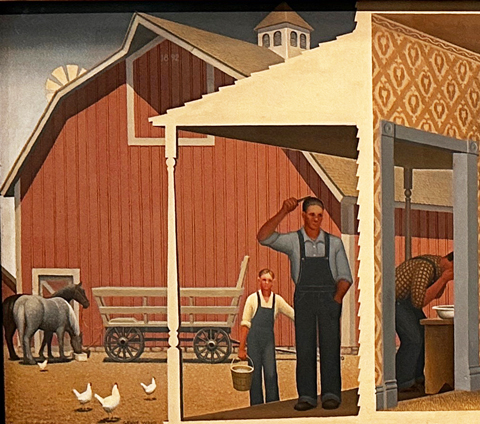 Grant Wood, Dinner for Threshers, the left side |
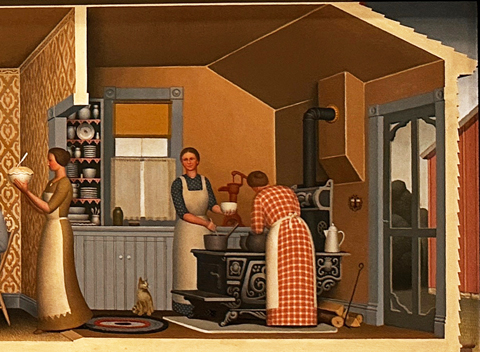 Grant Wood, Dinner for Threshers, the right side |
|
|
||
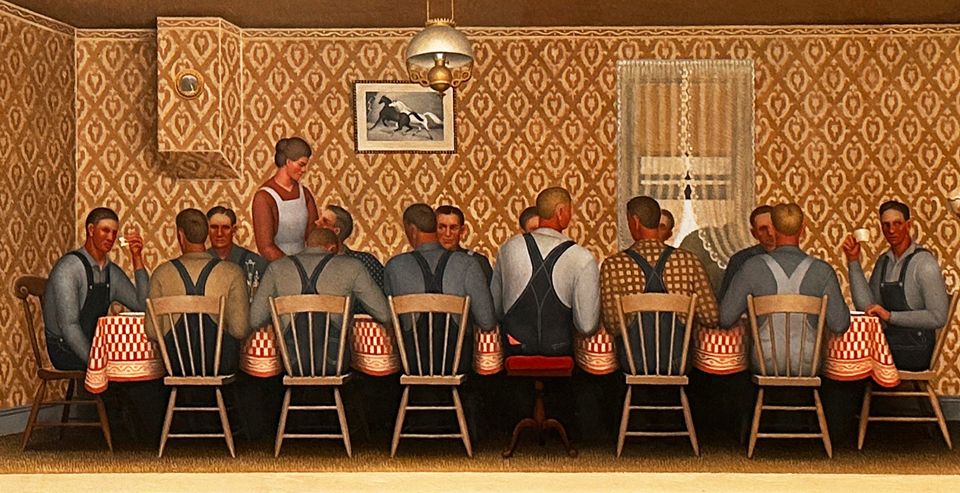 Grant Wood, Dinner for Threshers, center |
||
|
||
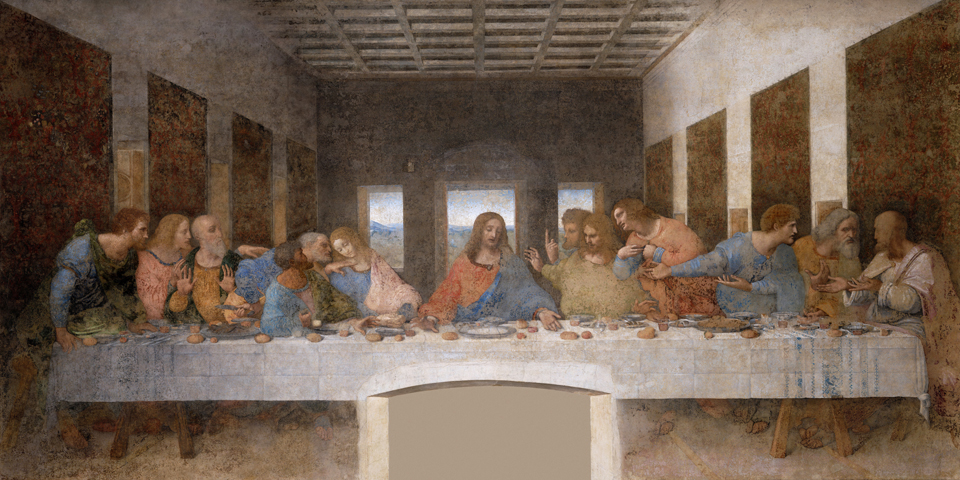 Leonardo da Vinci, The Last Supper, 1495-1498, Santa Maria delle Grazie, Milan |
||
| A bit more about telling stories visually ... | ||
|
||
| Dinner for Threshers at the de Young Museum, San Francisco | IMDB, Moonrise Kingdom | | ||
| Gallery News | ||||||||||
|
| ... in and around Bodega Bay | ||
 |
Bodega Bay Heritage Gallery 1580 Eastshore Road Between the Terrapin Creek Cafe and Roadhouse Coffee open Thurs-Sun, 11am to 6pm -- other times by chance or appointment an exceptional collection of late 19th and early 20th century paintings by well-known California artists http://www.BodegaBayHeritageGallery.com | Call or Text 707-875-2911 email: Art@BodegaBayHeritageGallery.com |
 "Mendocino Coast" Joshua Meador |
 Ren Brown |
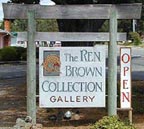
The Ren Brown Collection Just steps away from Bodega Bay Heritage Gallery A sumptuous gallery experience ... Contemporary Japanese Prints, Handmade Ceramics & Jewelry, Japanese Antiques, California Artists & Sculptors 1781 Coast Highway One, Bodega Bay, 94923 |
 |
|
Linda Sorensen Paintings Linda paints colorful and imaginative / modernist-transcendental-influenced |
 |
 |
In the nearby town of Bodega ... Dodrill Gallery 17175 Bodega Highway, Bodega CA 94922 Famed photographer, world adventurer and rock climber Jerry Dodrill exhibits and sells and his exceptional landscape photographs ... https://jerrydodrill.photoshelter.com/p/page2 | 707-377-4732 Photo@JerryDodrill.com |
 |
 |
In the nearby town of Bodega ... Artisans' Co-op featuring the talents of local artists ... photography, paintings, textiles, jewelry, ceramic and wood art 17175 Bodega Highway, Bodega CA 94922 ... http://www.artisansco-op.com| 707-876-9830 |
|
 |
Bodega Gallery in the historic town of Bodega (This gallery has closed, with a for sale sign posted) |
 |
 |
Bodega Bay's John Hershey Photography Bodega Bay resident photographer John Hershey displays his scenic shoreline and sea life images locally in restaurants, visitor venues and art shows. His 50 year career has encompassed multimedia production, commercial and personal photography, environmental portraiture, and community photojournalism. John recently added interpretive infrared photography to his portfolio. John Hershey Photography Portfolio ... http://www.jhersheyphoto.com John Hershey Photography Sales ... https://j-hershey-media.square.site |
 |
\ |
Bodega Bay's Jean Warren Watercolors Bodega Bay resident Jean Warren says her paintings are reflections of the places she has lived and traveled. Jean is a Signature member of the National Watercolor Society, California Watercolor Association and full member of Society of Layerists in Multi-Media. http://www.JeanWarren.com / 707-875-9240 |
|
| Also in Sonoma County ... | ||
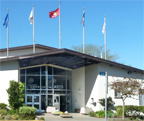 |
IN SEBASTOPOL - Sebastopol Center for the Arts |
|
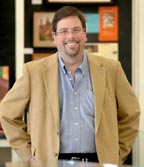 Corrick's Keven Brown |
IN SANTA ROSA Corrick's Art Trails Gallery | http://www.corricks.com/arttrailsgallery 637 Fourth Street, Santa Rosa, CA 95401 | Contact:: http://www.corricks.com/contact-us Corrick's has been a Santa Rosa Treasure since 1915, a downtown stationery store serving as the community's "cultural hub." Corrick's has long supported local artists with its impressive "ART TRAILS GALLERY," including paintings by Linda Sorensen. Corricks offers a number of originals by famed Santa Rosa artist, Maurice Lapp ... (see our August 2017 article) located on Fourth Street, steps away from Santa Rosa's revitalized town square and Fourth Street's Russian River Brewery |
 Linda Sorensen's White Barn circa 1880, Sea Ranch currently available at  |
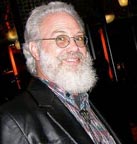 Dennis Calabi |
Calabi Gallery currently online only ... CalabiGallery.com email: info@calabigallery.com | 707-781-7070 Famed master conservator Dennis Calabi brings his rare knowledge and experience to present a tasteful and eclectic array of primarily 20th century artwork. http://www.calabigallery.com |
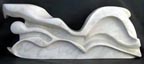 Easton, Crustacean Dancing Dream, American Alabaster |
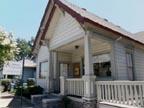 |
IN Santa Rosa - The Annex Galleries specializing in 19th, 20th, and 21st century American and European fine prints The Annex Galleries is a member of the International Fine Print Dealers Association (IFPDA). http://www.AnnexGalleries.com |
|
 |
IN Tomales - Sky Ranch Gallery local Sonoma County Artists Thank you for visiting our gallery's website. In July of 2025, a group of local artists banded together wanting to bring art to the community of Tomales. http://www.skyranchgallery.com |
|
 |
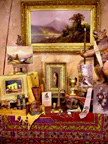
IN GRATON - Graton Gallery |
|
 |
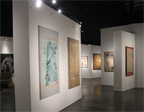
IN DUNCANS MILLS - Christopher Queen Galleries 3 miles east of Hwy 1 on Hwy 116 on the Russian River http://www.christopherqueengallery.com |707-865-1318 Established in 1976, the gallery features Early California and Contemporary art. |
|
 |
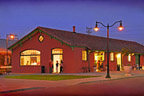
IN Healdsburg - Paul Mahder Gallery http://www.paulmahdergallery.com (707) 473-9150 | Info@paulmahdergallery.com 222 Healdsburg Avenue, Healdsburg, CA 95448 | check for hours |
|
 |
|
 |
| Links to current museum exhibits relevant to Early California Art | |||
| The Greater Bay Area | |||
| The Walt Disney Family Museum -- see website for details This museum tells Walt's story from the early days. (on the Parade Grounds) 104 Montgomery Street, The Presidio of San Francisco, CA 94129 -- view location on Google Maps -- |
 |
San Francisco ... see website de Young Museum Permanent Collection |
 |
| San Francisco closed, see website California Historical Society |
 |
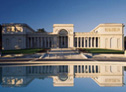
San Francisco Legion of Honor ... see website -Permanent European and Impressionist Paintings |
 |
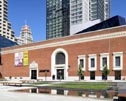
| San Francisco open, see website for details Contemporary Jewish Museum |
 |
Oakland ... see website Oakland Museum of California -- ongoing Gallery of California Art -showcasing over 800 works from the OMCA's collection |
 |
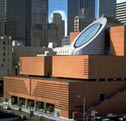
San Francisco |
 |
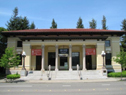
Santa Rosa |
 |
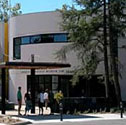
| Santa Rosa ... see website Charles M. Schultz Museum |
 |
Sonoma |
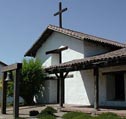 |
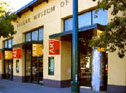
| Sonoma Sonoma Valley Museum of Art ... see website 551 Broadway, Sonoma CA (707) 939-7862 |
 |
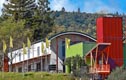
Yountville The Napa Valley Museum 55 Presidents Circle Yountville, CA 707-944-0500 |
 |
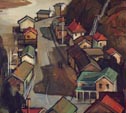
| Bolinas Bolinas Museum ... see website featuring their permanent collection, including Ludmilla and Thadeus Welch, Arthur William Best, Jack Wisby, Russell Chatham, Alfred Farnsworth. |
 |
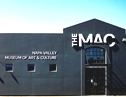
St Helena Napa Valley Museum of Art and Culture St. Helena |
 |
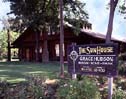
| Ukiah Grace Hudson Museum ... see website http://www.gracehudsonmuseum.org |
 |
Moraga |
 |
| Walnut Creek ... see website The Bedford Gallery, Lesher Center for the Arts |
 |
San Jose San Jose Museum of Art ... see website approximately 2,000 20th & 21st century artworks including paintings, sculpture, new media, photography, drawings, prints, and artist books. |
 |
| Monterey Monterey Museum of Art ... see website Ongoing exhibitions ... Museums Permanent Collection including William Ritschel, Armin Hansen and E. Charlton Fortune http://www.montereyart.org |
 |
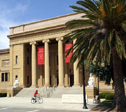
Palo Alto ... see website Cantor Art Center at Stanford University |
 |
Monterey |
 |
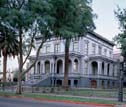
Sacramento Crocker Art Museum ... see websites |
 |
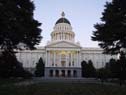
| Sacramento Capitol Museum ... see website Governor's Portrait Gallery Permanent Exhibits (including one of our galllery's favorite artists, Robert Rishell's portrait of Gov. Ronald Reagan |
 |
Stockton's Treasure! The Haggin Museum ... see website -Largest exhibition of Albert Bierstadt paintings anywhere, plus the works of Joseph Christian Leyendecker, Norman Rockwell's mentor. see our Newsletter article, April 2011 |
 |
| Southern California (and Arizona) (for all museums below, see websites for hours and protocols. | |||
| Los Angeles Los Angeles Museum of Art Art of the Americas, Level 3: Artworks of paintings and sculptures from the colonial period to World War II— a survey of of art and culture & "Levitated Mass" |
 |
Irvine UCI IMCA (University of California, Irvine Institute and Museum of California Art) (formerly The Irvine Museum) |
 |
| Santa Barbara The Santa Barbara Museum of Art |
 |
Orange Hilbert Museum, Chapman University |
 |
| San Diego San Diego Museum of Art Permanent Collection |
 |
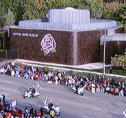
Pasadena Norton Simon Museum -an Impressive Permanent collection, European impressionist and post impressionist paintings See our newsletter from March 2014 |
 |
| Los Angeles California African American Art Museum adjacent to the LA Coliseum (see our newsletter articleof their Ernie Barnes Exhibition September 2019) |
 |
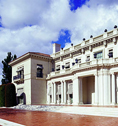
San Marino (near Pasadena) The Huntington Library American Art Collection Paintings by John Singer Sargent, Edward Hopper, Robert Henri, Albert Bierstadt, Thomas Moran, William Keith, Mary Cassatt, Thomas Hart Benton and many more. |
 |
| Phoenix, AZ Phoenix Art Museum an excellent sampling of Artists of the American West |
 |
Palm Springs |
 |
| & Beyond | |||
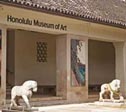
| Honolulu, HI Honolulu Museum (see our Newsletter article from February, 2015) |
 |
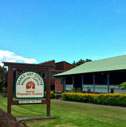
Kamuela, HI (Big Island) Issacs Art Center 65-1268 Kawaihae Road Kamuela, HI 96743 (See our Dec '16 article "Hawaii's Paul Gauguin," modernist Madge Tennent, 1889-1972) |
 |
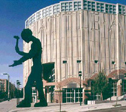
| Seattle, WA Seattle Art Museum ( see our article Mar 2018 French and American Paintings ) |
 |
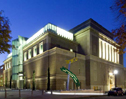
Portland, OR Portland Art Museum Permanent Collection: American Art |
 |
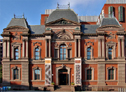
| Washington D.C. The Renwick Gallery Permanent ... Grand Salon Paintings from the Smithsonian American Art Museum |
 |
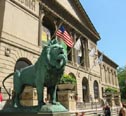
Chicago, IL Art Institute of Chicago Permanent collection: the Impressionists |
 |
| Cedar Rapids, IA The Cedar Rapids Museum of Art Grant Wood: In Focus is an ongoing permanent collection exhibition. |
 |
Bentonville, AR |
 |
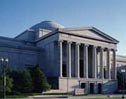
| Washington D.C. The National Gallery Permanent collection American Paintings |
 |
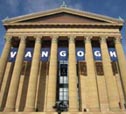
Philadelphia , PA The Philadelphia Museum of Art |
 |
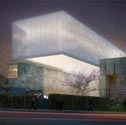
| Philadelphia , PA Barnes Foundation, Philadelphia Campus |
 |
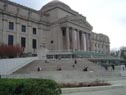
Brooklyn, NY The Brooklyn Museum American Art Permanent Collection |
 |
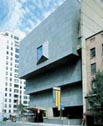
| New York , NY The Whitney Museum of American Art The largest selection of works by Edward Hopper |
 |
New York, NY Metropolitan Museum of Art Its extensive collection of American Art |
 |
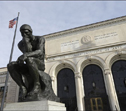
| Detroit, MI Detroit Institute of Arts American Art Permanent Collection |
 |
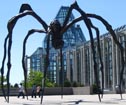
Ottawa, Ontario National Gallery of Canada |
 |
| Denver, CO Denver Art Museum |
 |
Boston, MA |
 |
| If you wish to sell a painting to us ... |
|