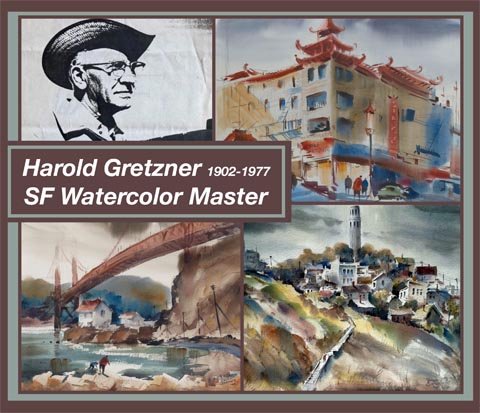
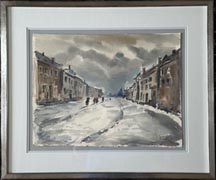
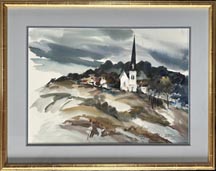
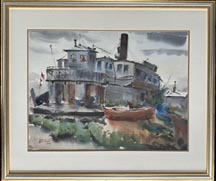
Harold Gretzner was a Bay Area treasure. As a regional watercolor master, he painted scenes of San Francisco, the Bay and surrounding areas. His paintings are a bit gritty, urban and industrial. His preferred subjects included streets, docks, warehouses, boats, old houses and Chinatown.
Gretzner was born in Baltimore. He trained at the Washington School of Art in Washington D.C. and the California College of Arts and Crafts in Oakland.
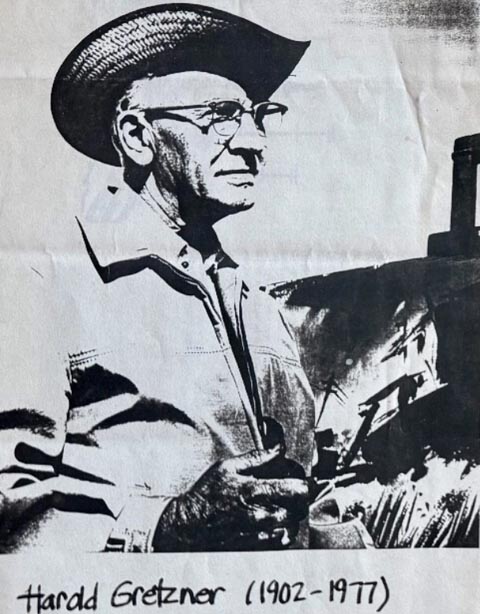
He worked in San Francisco as an artist-lithographer for thirty years. An interview with his widow, Teckla Gretzner, revealed that Harold's routine was to get up before dawn, begin his drive to work in San Francisco. But most days, he would stop along the way to paint. This is a discipline he maintained for years.
Gretzner was a close friend and painting partner of Maurice Logan (one of Oakland's Society of Six). Both Gretzner and Logan were associated with the Thirteen Watercolorists (of Oakland) and the West Coast Watercolor Society. The Thirteen Watercolorists held annual exhibitions in San Francisco during the late 1930's until 1947. Harold, after retiring from his lithography job in 1960, devoted his time to painting and was a popular watercolor teacher. For many summers, Harold Gretzner co-taught watercolor classes at Asilomar Conference Center in Monterey with his friend, water color painter, Jade Fon.
His paintings are in the UC Irvine Langson Museum, the Buck Collection, Pennsylvania Academy of Fine Arts and the Hilbert Museum of California Art in Orange, California.
California Style Watercolor combines direct observation of the subject, use of wet-into-wet transparent color, with bold design accompanied with an unusually strong sense of light. It is less concerned with detail and more with atmosphere of a particular time and a place.
Gretzner's style began with controlled wet into wet with broad passages of diffused pigment establishing atmosphere and light. Then with applied calligraphic strokes, he provided structure and definition. He doesn't attempt to portray any scene accurately. Instead he seeks to capture the atmosphere, light and rhythmic forms, usually with a visual anchor.
Note -- Regarding our gallery's painting Coit Tower above, the January 9, 1997 edition of the the LA TIMES reviewed California Watercolors of the Jonathan Art Foundation and the Jonathan Club at the Carnegie Art Museum in Oxnard. They described Coit Tower which was on view as part of this exhibition as "a spire on a hill amid a meandering group of ramshackle houses."
The LA Times article characterized the San Francisco paintings of this exhibition as "a kind of glowing light." It placed Gretzner among the California Style watercolor painters who transformed urban subjects. Rather than presenting the harsh, congested city environment, these California Style watercolor painters softened their scenes into atmosphere and light, with architecture being only part of the whole scene.
|
From our October 2026 Newsletter ...
|
Harold Gretzner,
California Style Watercolors,
Visual Poetry |
Harold Gretzner's paintings are visual poetry.
His scenes capture the feeling of a place in a particular moment. He purposely avoided unnecessary detail. He wasn't taking a photograph. He wanted only the suggestion of his subject, just enough to convey its character and the atmosphere of the moment.
Harold painted scenes throughout the San Francisco Bay Area and its surrounding communities. He began many of his paintings on a full sheet of watercolor paper. Next, he would wet the paper and, using thin, transparent washes of color, establish the sky and atmosphere with the technique known as "wet into wet." This first step created the atmospheric backdrop for his scene. He then introduced darker, bolder colors to suggest the buildings, boats, streets, figures and other elements within that atmosphere.
The resulting painting is a dream, a poetic composition filled with the feeling of the place.
|
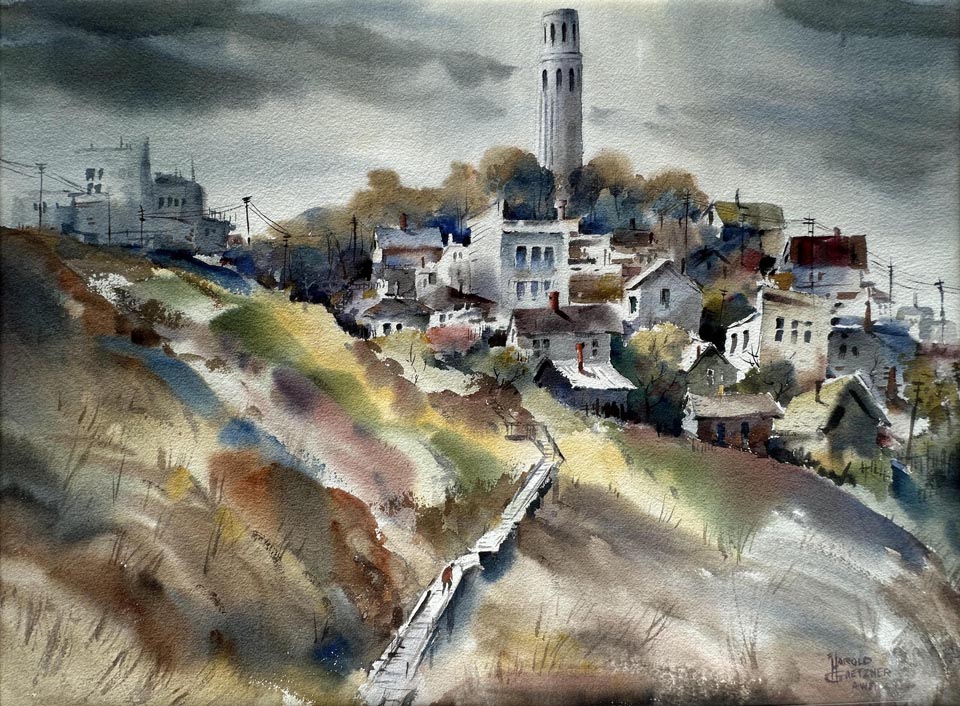
Harold Gretzner, San Francisco's Coit Tower nearly a century ago, available, Bodega Bay Heritage Gallery Collection |
Gretzner was one of a very large and talented group of artists who painted California scenes in a distinctive approach that has come to be known as California Style Watercolor. |
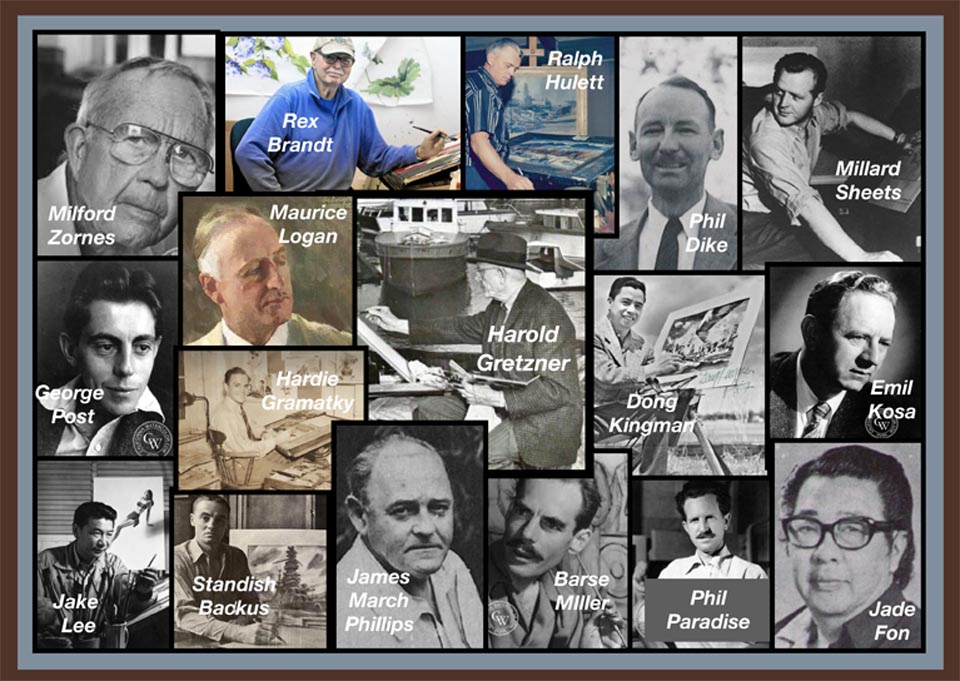
Here are some of the of the well known artists who
were part of the
California Stye Watercolor Movement, from both Northern and Southern California |
California Style Watercolor
Once the atmospheric background was established, California Style watercolorists turned their attention to the structures, landscapes and figures existing within it. Rather than painstakingly rendering every detail, they reduced their subjects to essential shapes, masses and patterns. The result was often dreamlike—paintings that conveyed not simply what a place looked like, but what it felt like to be there.
|
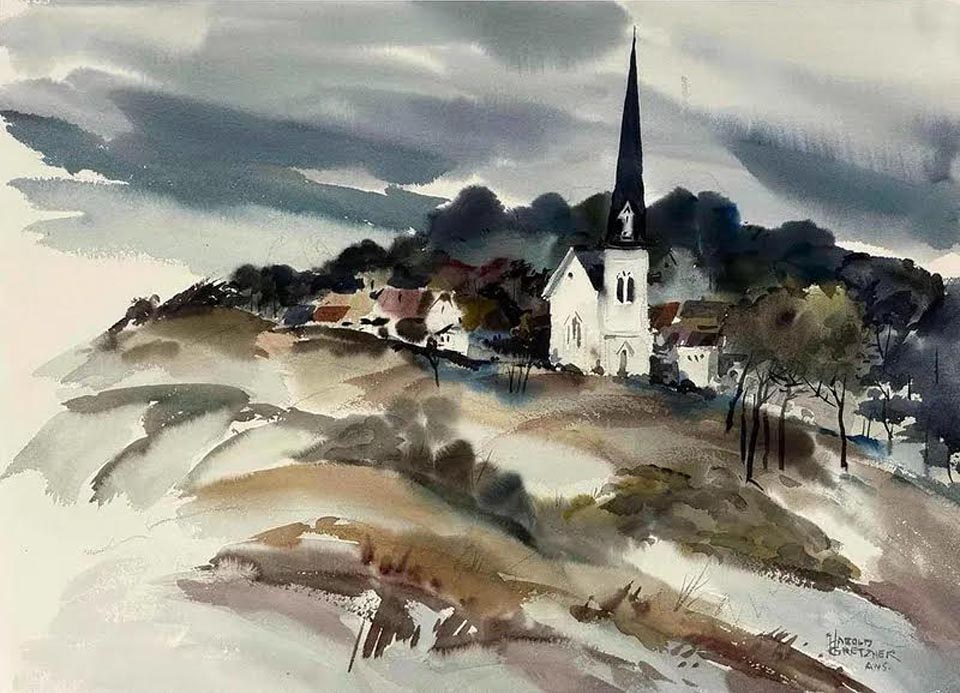
Harold Gretzner, Mendocino Presbyterian Church, available, Bodega Bay Heritage Gallery Collection |
(Mendocino Presbyterian Church is quite a noticable landmark, and is listed on the National Register of Historic Places and is California Landmark #714.)
California Style watercolorists commonly began with a thoroughly wetted sheet of paper and transparent watercolors, allowing colors to bleed and mingle with one another. They also deliberately left portions of the paper untouched, using the natural white of the paper as an active color and compositional element.
Through this combination of wet-into-wet washes and passages of untouched paper, the artists established the light and atmosphere into which the rest of the painting would unfold.
As the painting progressed, they added the essential elements of the scene—plants, structures, boats, vehicles and people—often with bolder, more intensified colors and more defined lines. Visual information was deliberately reduced. Unnecessary details were eliminated, leaving only those elements that strengthened the composition.
The result was a distinctive kind of watercolor: spontaneous, economical and alive with atmosphere.
|
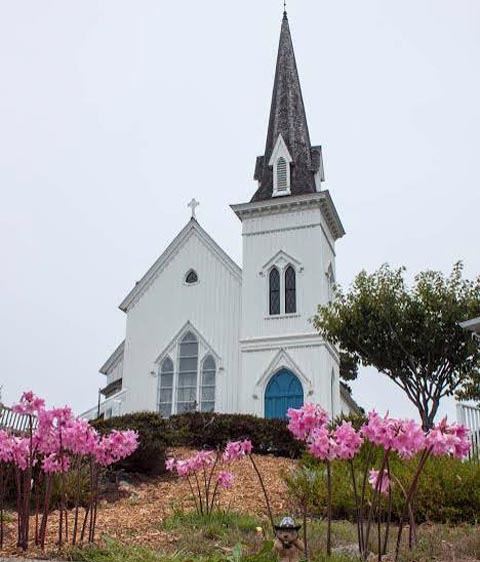
Mendocino Presbyterian Church
pictured here with Naked Ladies in bloom in front ot the church. |
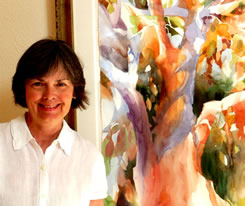
Bodega Bay Watercolor artist and teacher
Jean Warren
|
Jean Warren, (JeanWarren.com) is a a well-known contemporary Bodega Bay watercolor artist and teacher. She studied with several important California Style artists, including George Post and Milford Zornes. She recalled that these artists were not particularly interested in rendering detail or photographic accuracy. They weren't trying to take pictures. They were trying to expressively capture the feeling of a place.
Jean told of me of one artist with a memorable technique. He would wear a pair of glasses coated with Vaseline, deliberately blurring details of his subject while allowing general shapes and colors to remain visible. It was an interesting practical technique for capturing the world as he wanted to paint it.
|
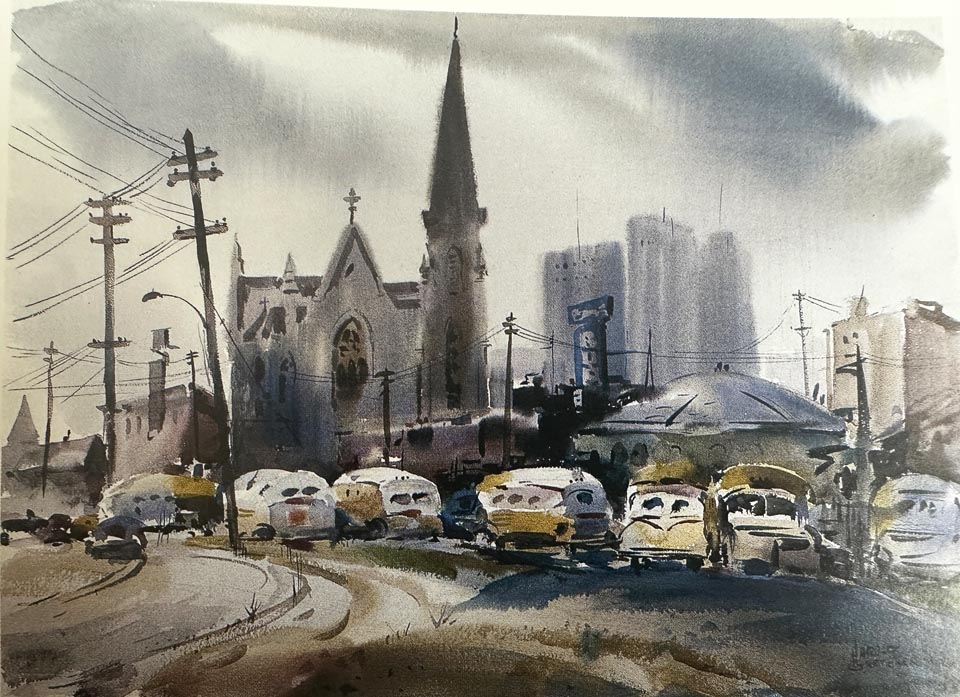
Harold Gretzner, Bus Depot, Oakland, Jeff Olson Collection, with Oakland's Saint Francis de Sales Cathedral
from Gordon McClelland's California Watercolors (1850-1970): An Illustrated History and Biographical Dictionary
(2002) |
(Saint Francis de Sales wass built in 1893, and served as the cathedral of the Roman Catholic Diocese of Oakland from 1962 until it was damaged in the 1989 Loma Prieta Quake. The church was demolished three years later.)
Jean Warren went on explaining that other artists not using vasiline glasses did use a well tuned editorial eye as they painted. Their painting process was an exerise in continually editing their compositions, retaining only those elements that contributed to their overall design. She also noted their use of balance. In a predominantly horizontal composition, for example, an artist might deliberately introduce a single strong vertical element to give the painting visual equilibrium.
|
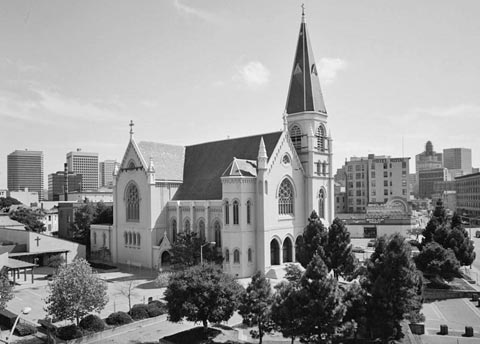
Saint Francis de Sales, Oakland
|
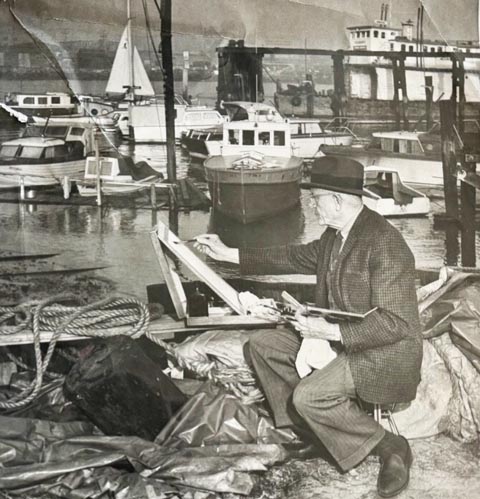
Harold on one of his routine early morning plein air painting sessions |
The Northern California branch of the California Style watercolor movement focused on the Bay Area's changing light, fog and atmosphere, painting scenes of urban streets, harbors, dry docks and industrial landcapes. The Southern California branch painted the Southland's brilliant sunshine, palm and eucalyptus trees, and Sun drenched valleys.
San Francisco was an environment particularly well suited to Harold Gretzner.
In California Watercolors 1850-1870 by Gordon McClelland and Jay T. Last, they wrote, "For over thirty years, Gretzner followed a routine.
In the predawn morning, providing the weather cooperated, he would wake up and drive toward his workplace in San Francisco where he worked as a lithographer. Along the way, he would stop and paint a watercolor."
|
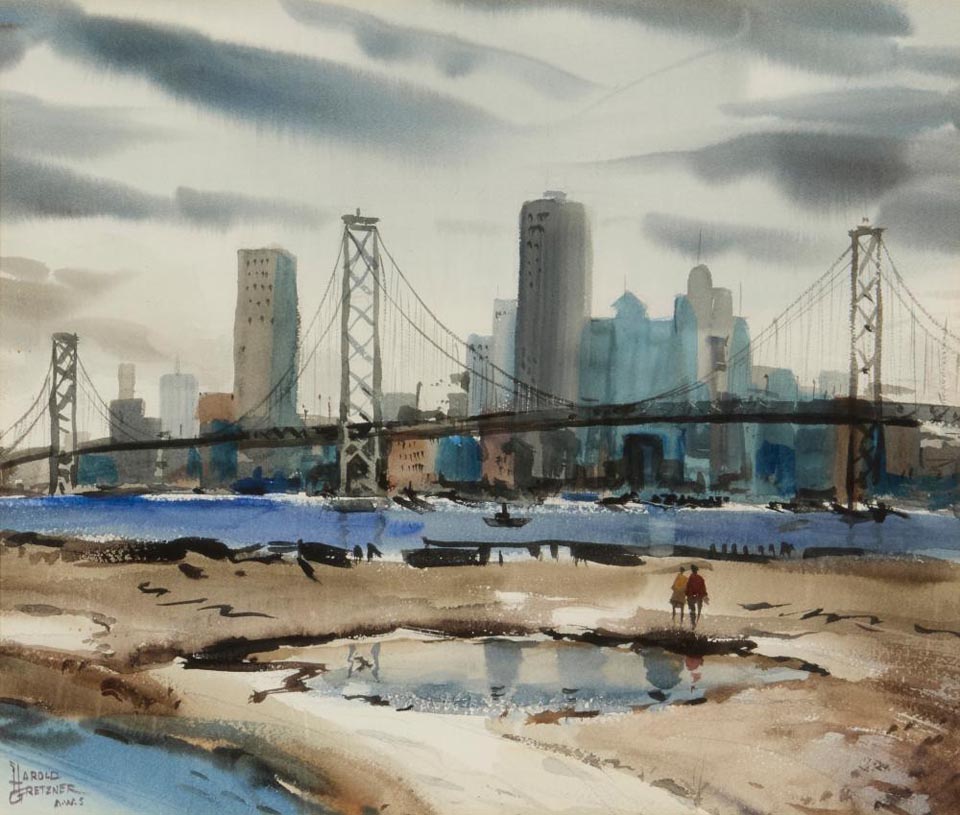
Harold Gretzner, San Francisco Bay Bridge, Private Collection |
Harold Gretzner
Gretzner was a member of The Thirteen Watercolorists, an Oakland-based group founded by the distinguished watercolorist Maurice Logan. Gretzner and Logan often ventured out together on painting expeditions and were frequently worked together organizing exhibitions featuring members of the group.
|
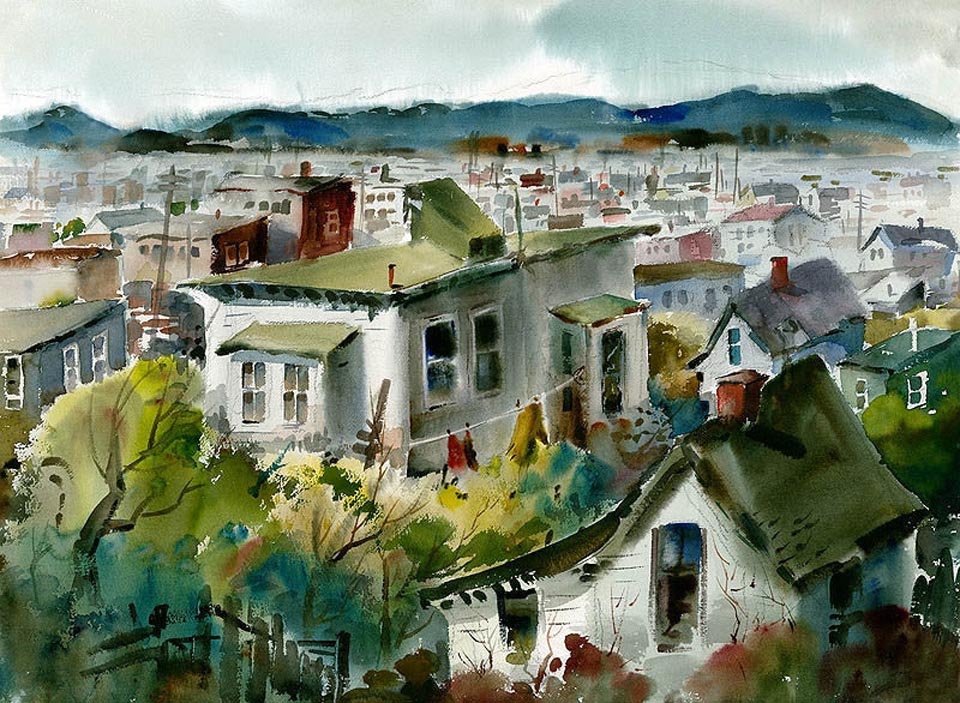
Harold Gretzner, San Francisco Rooftops, Private Collection
|
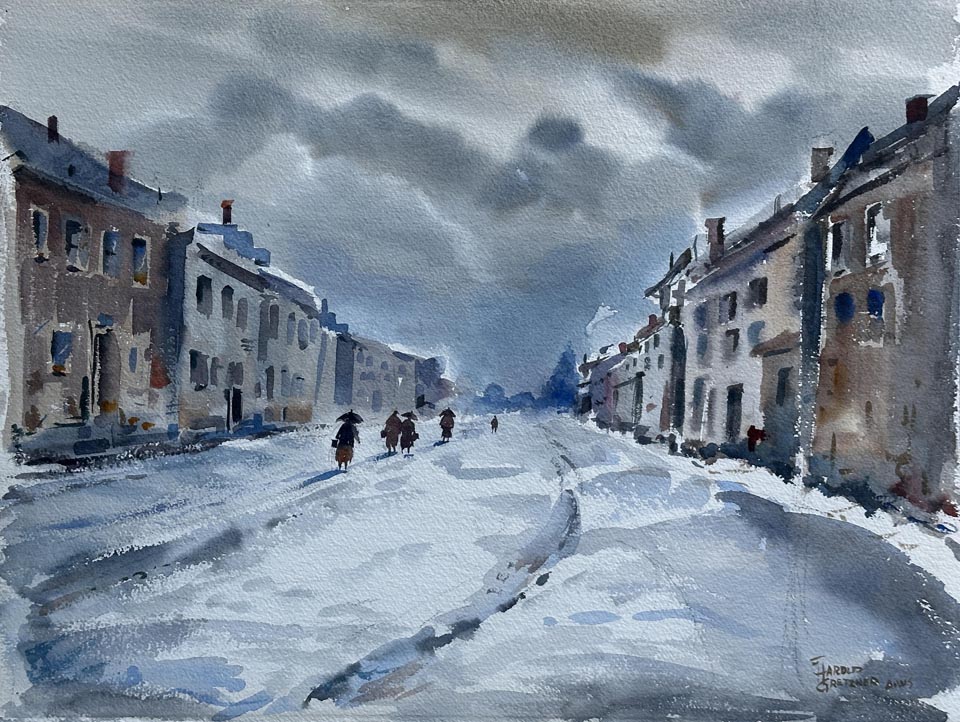
Harold Gretzner, Snowy Cobblestones, available, Bodega Bay Heritage Gallery Collection
|
Gretzner came to California in the mid-1920s, having grown up in Baltimore and studied art in Washington, D.C. An adventurous young artist, he moved west to the San Francisco Bay Area, where he continued his education at the California College of Arts and Crafts in Oakland.
We suppose Snowy Cobblestones was done on the East Coast after one of their rare heavy wet snowstorms. It was most likely painted before Gretzner's move to the Bay Area in 1922. It could be a scene row houses inWashington, D.C. or his native Baltimore. |
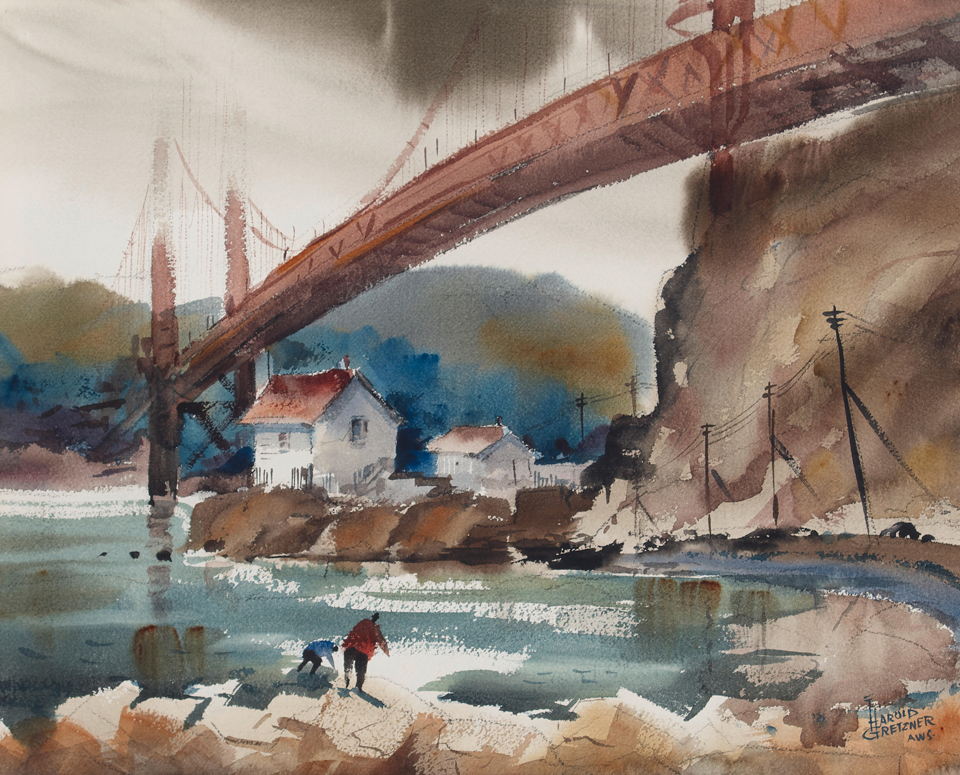
Harold Gretzner, Golden Gate North Tower, Lime Point, Private Collection |
For more than fifty years, Gretzner painted the Bay Area and its surroundings, creating wonderfully atmospheric scenes of a California that was changing rapidly around him.
In preparing this article, I looked at a large number of images of Gretzner's work. The more I looked, the more convinced I became that Gretzner understood a fundamental artistic principle: less is more.
|
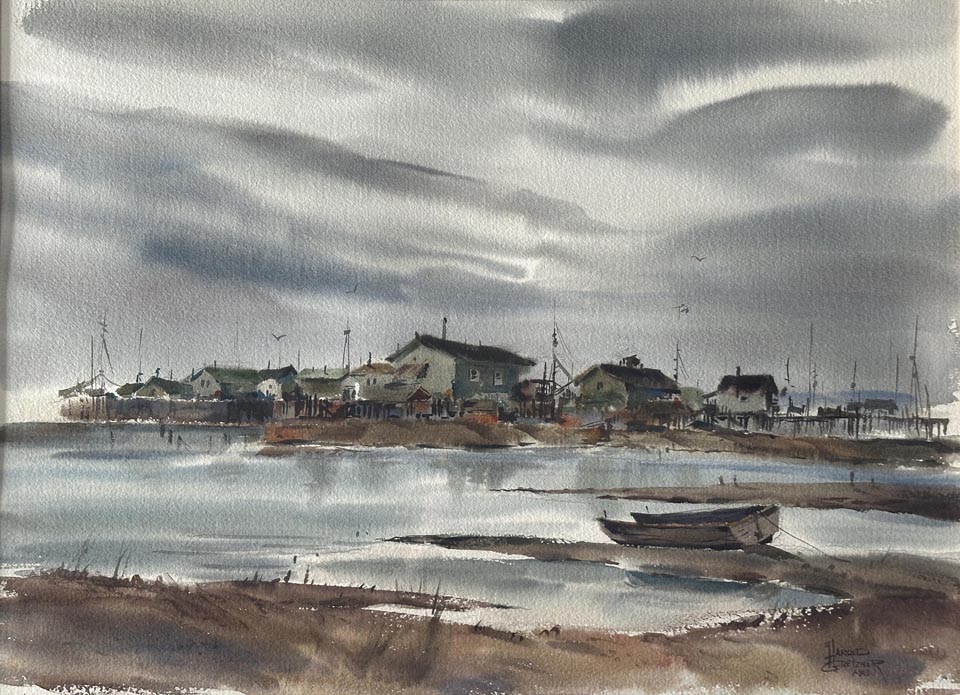
Harold Gretzner,Beached Boat, available, Bodega Bay Heritage Gallery Collection |
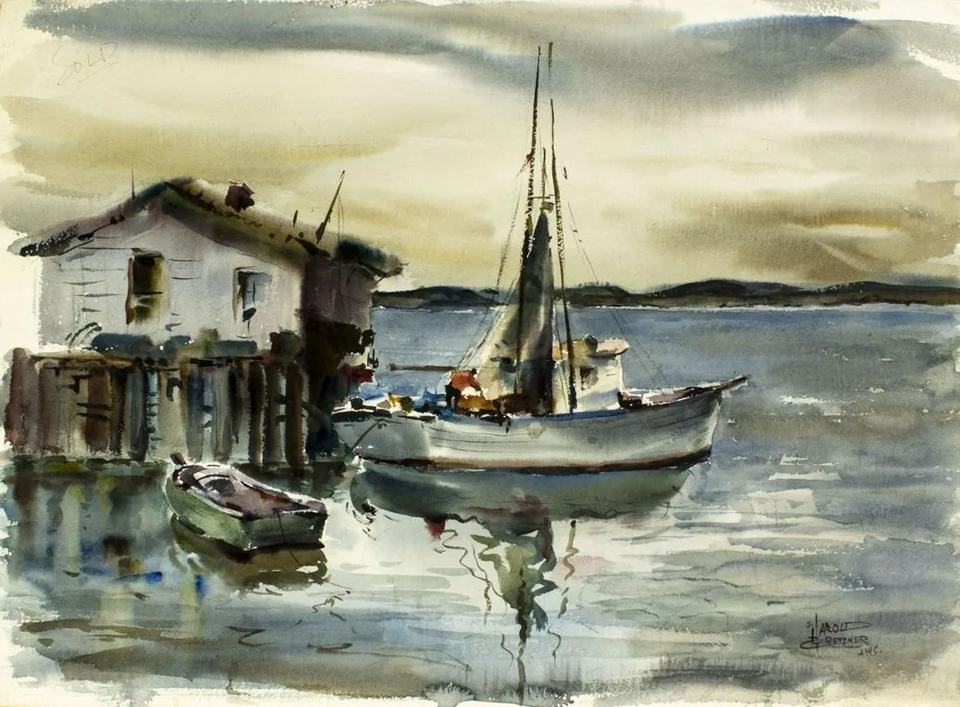
Harold Gretzner, Fisherman Heading Out, Private Collection
|
He was remarkably expressive and economical with his brushwork. With a few carefully chosen strokes, he could suggest a building, a boat, a street or a human figure without laboriously describing it.
|
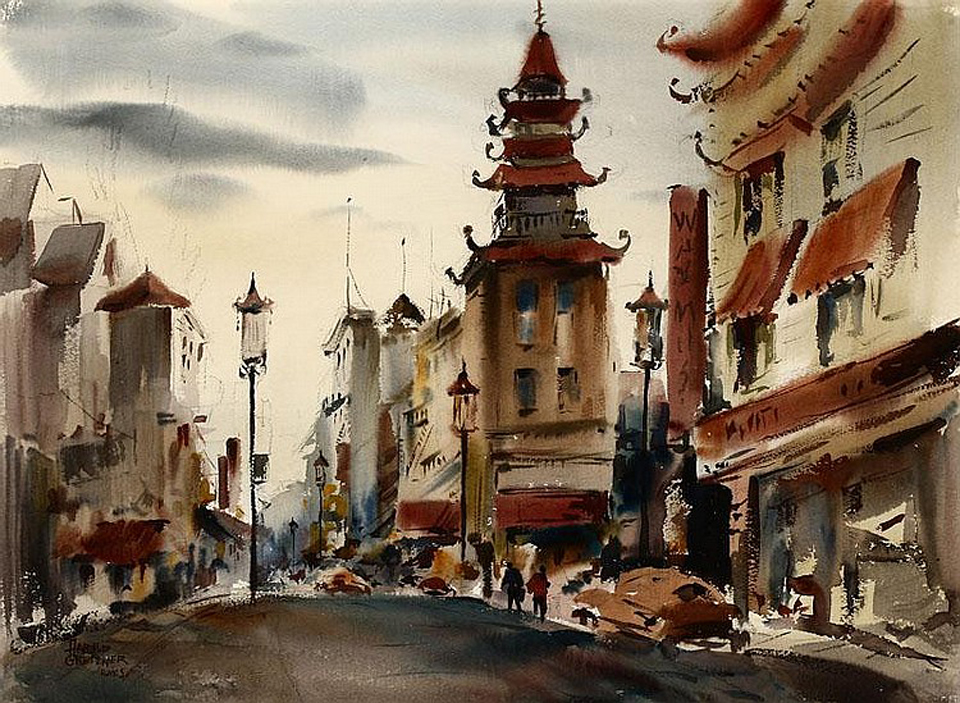
Harold Gretzner,Chinatown Street Scene, Private Collection |
He gives us enough information to recognize his subject, but never so much that the subject overwhelms the atmosphere. One of his favorite places to paint was Chinatown, a busy place with interesting architecture, scents, sounds, and people.
I think this is what motivated Gretzner. He wasn't painting places, he was painting his impressions of life in those places, memories of light, weather, color and human activity distilled into watercolor.
They are, in the truest sense, visual poetry.
|
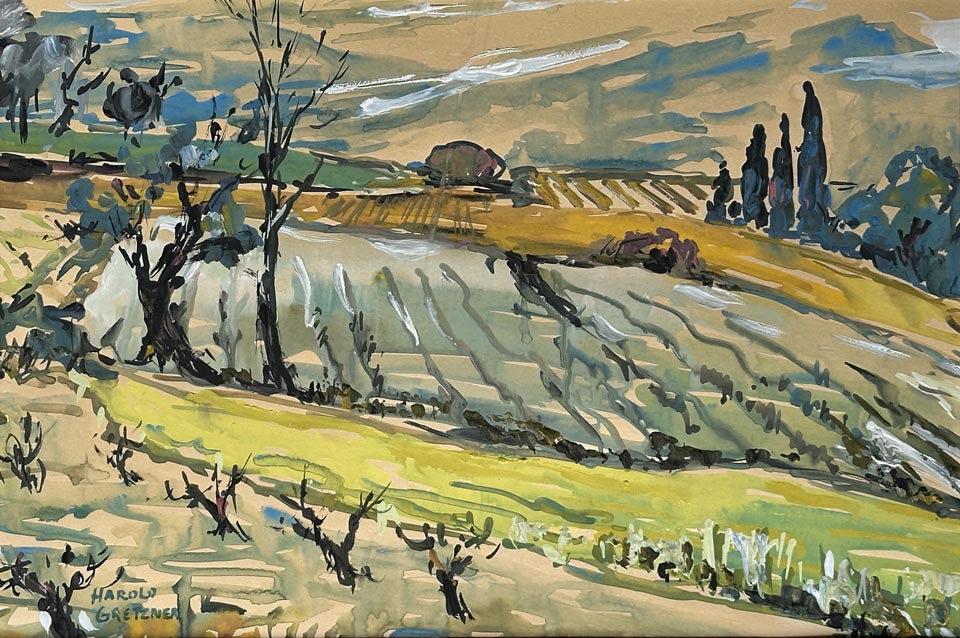
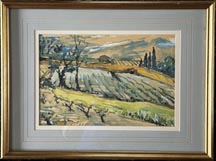
Harold Gretzner, Rolling Vineyards, watercolor and gouache, available, Bodega Bay Heritage Gallery Collection |
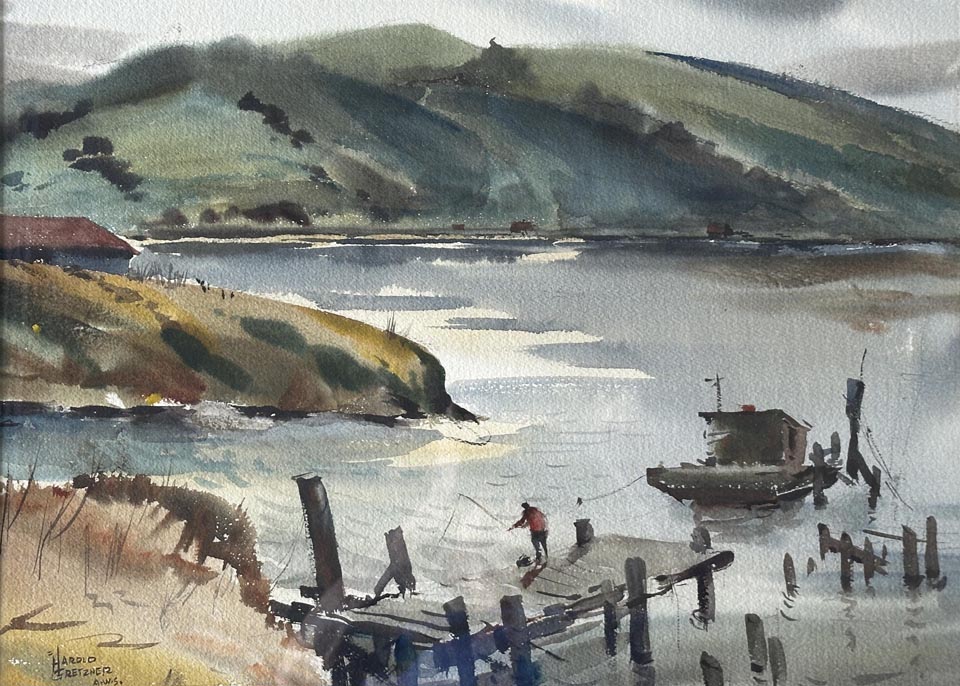
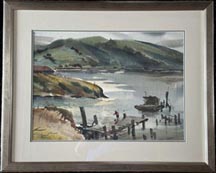
Harold Gretzner, Bayside Pier Fishing, available, Bodega Bay Heritage Gallery Collection |
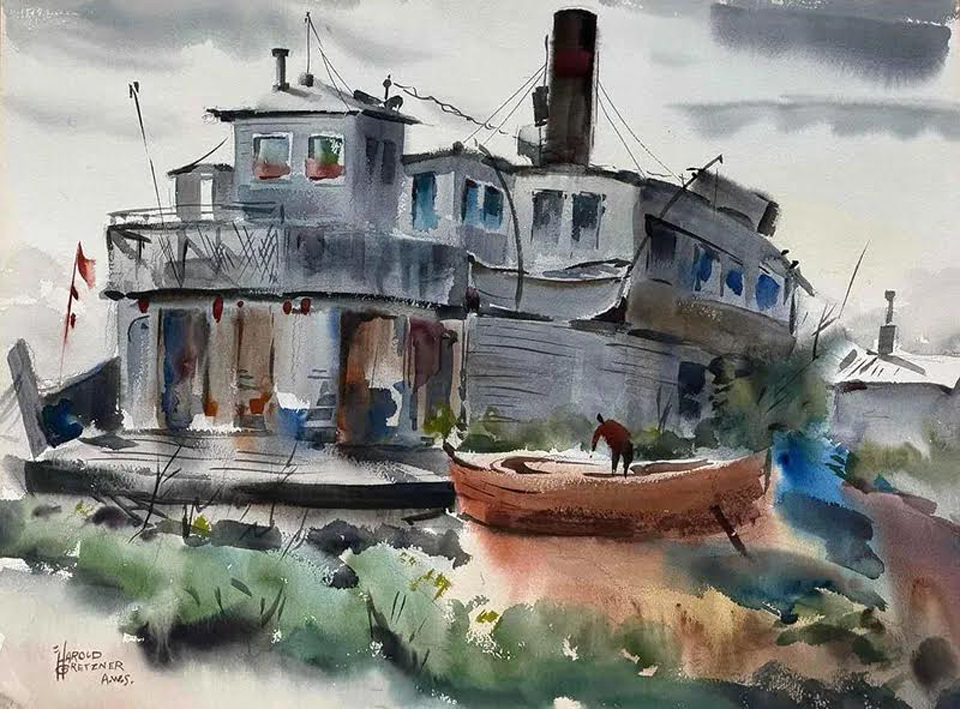
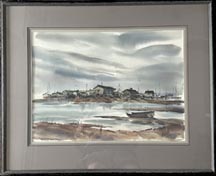
Harold Gretzner, Bayside Houseboat, available, Bodega Bay Heritage Gallery Collection |
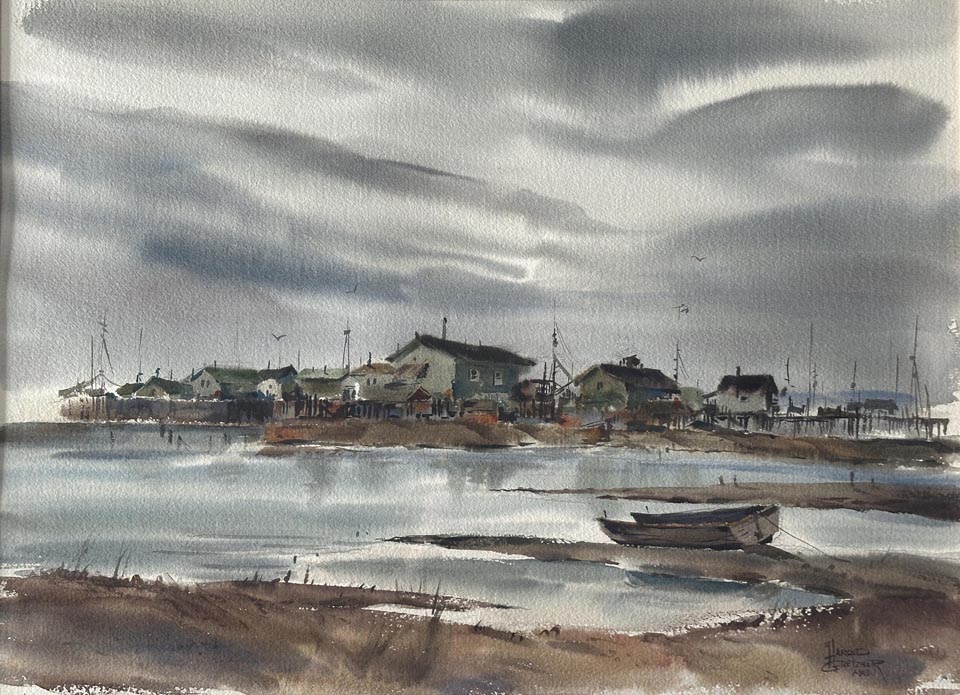
Harold Gretzner, Beached Boat, Bodega Bay Heritage Gallery Collection |
Gretzner at the Gallery
Currently, our gallery has seven Harold Gretzner watercolors. They will be on display and are available at the gallery through October. Check out his page on our website.
( https://bodegabayheritagegallery.com/Gretzner_Harold.htm )
|
|