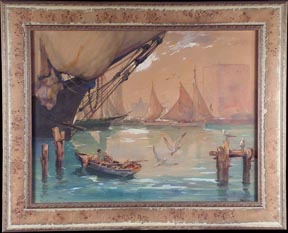
Boys Fishing on the Bay - 1940
watercolor |
Davis Francis
Schwartz
Resident artist
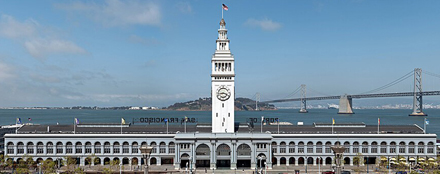
of SF's Ferry Building
Click to see
our Aug '26 article
|
 |
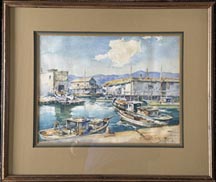
Fishing Boats Dockside, SF
watercolor |
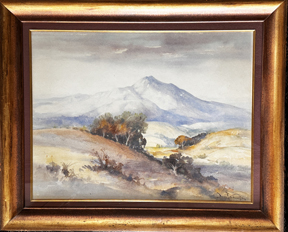
Mount Tamalpais
watercolor |
 |
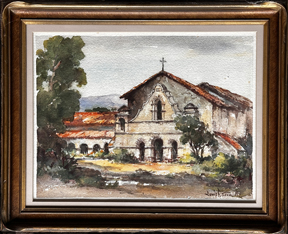
Mission San Antonio de Padua
watercolor |
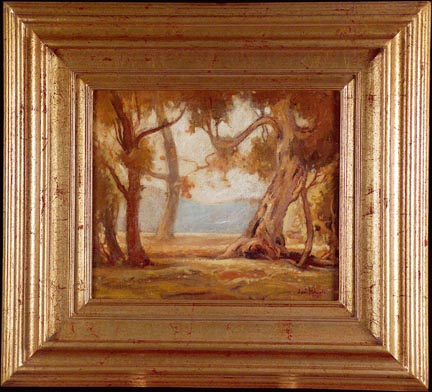
California Live Oaks, 1935
oil on canvas laid down on paperboard |
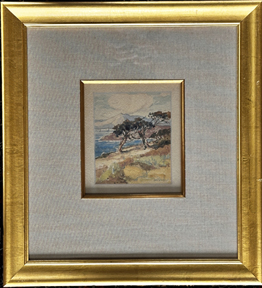
San Francisco Bay Sailing
watercolor |
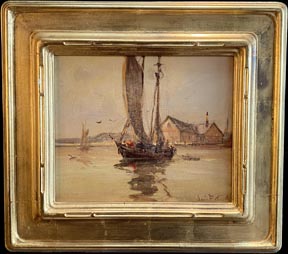
Embarking Schooner
oil on canvas |
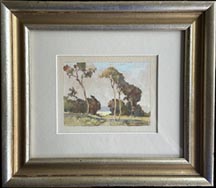
Path to the Bay
watercolor |
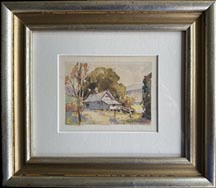
Corte Madera Creek Cabin
watercolor |
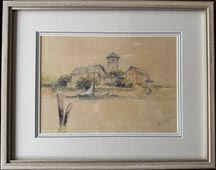
Sailing By
watercolor |
Why did San Francisco's Ferry Building have a resident artist?
In 1923, San Francisco was the booming capital of the West. Because the Bay Bridge and the Golden Gate weren't built until the 1930's, everyone who came to San Francisco entered the city by arriving at the Ferry Building. It was, in essence, California's front door.
With all these visitors coming through the Ferry Building, the Coastal Commission wanted the Ferry Building to promote California's great beauty, diversity and abundant opportunity.
|
| |
|
They commissioned a big public display, a 600 foot long relief map of California, showing its harbor, the agricultural valleys, and the grandeur of its mountains and vast deserts. They hired a southern California firm to build this map, install it on the Ferry Building's second floor, and hired an artist to care for it. Thousands of visitors saw the map and it made many impressions, sparked many discussions and and helped launch many dreams.
Davis Francis Schwartz was part of this project from its inception. He helped design, build and install this piece of public art, and once installed, he was chosen and hired to care for it. As part of his compensation, he was given a studio / gallery in the Ferry Building, giving him access to the map and a fantastic location to pursue his fine art painting.
Davis Francis Schwartz was a graduate of the Art Institute of Chicago, and was an experienced illustrator for the Cleveland Plain Dealer and the Los Angeles Times.
In 1909 when Schwartz joined entrepreneur and artist Gibson Catlett, whose firm specialized in spectacular bird's-eye perspective maps promoting new land developments. These paintings were far more than ordinary maps. Combining aerial perspective, architecture, landscape painting, and meticulous drafting, they presented entire communities in vivid three-dimensional views. Schwartz worked with Catlett in Los Angeles before moving with the company to Portland, Calgary, Toronto, Montreal, and Chicago.
The years spent producing panoramic land maps gave Schwartz an extraordinary command of topography and spatial perspective—skills that would define the next chapter of his career.
Returning permanently to California in 1920, Schwartz became one of the principal artists responsible for designing and constructing an astonishing three-dimensional relief map of the entire state of California. Measuring approximately 600 feet long, 18 feet wide, and weighing nearly 70 tons, the enormous model represented mountains, valleys, rivers, highways, and communities in remarkable detail. Popularly known as "Paradise in Panorama," it was described by Scientific American as the largest relief map in the world.
When the project was installed in San Francisco's Ferry Building in 1924, Schwartz relocated to the city and accepted the position of artist and caretaker for the map. For the next thirty years he maintained, restored, and continually updated this remarkable public attraction for the State Board of Harbor Commissioners. His responsibilities also included producing publicity artwork for the California State Chamber of Commerce, whose offices occupied the Ferry Building.
One of the great benefits of the appointment was a private studio inside the Ferry Building itself. There, overlooking San Francisco Bay, Schwartz devoted countless hours to his own paintings while surrounded daily by the scenery that inspired him. During these decades he produced the colorful Northern California landscapes, coastal scenes, and California mission paintings for which collectors know him today.
Schwartz worked comfortably in both oil and watercolor. His paintings combine careful observation with an illustrator's clarity of design and a cartographer's understanding of landforms. Mountains, rolling hills, and coastal headlands are rendered with convincing structure, while broad passages of luminous color create a distinctly California atmosphere.
Although his professional life centered on one of California's most ambitious public works projects, Schwartz never abandoned painting for its own sake. Friends remembered him as an endlessly creative artist whose illustrated letters, humorous sketches, and warm personality made him a beloved member of the artistic community centered around the Ferry Building.
Today, Davis Francis Schwartz occupies a unique place in California art history. Trained as an illustrator, refined through years of cartographic painting, and inspired by Northern California's extraordinary landscapes, he successfully bridged the worlds of commercial art and fine art. His paintings remain lasting records of the California he spent a lifetime studying—both from the painter's easel and from the mapmaker's remarkable eye.
|
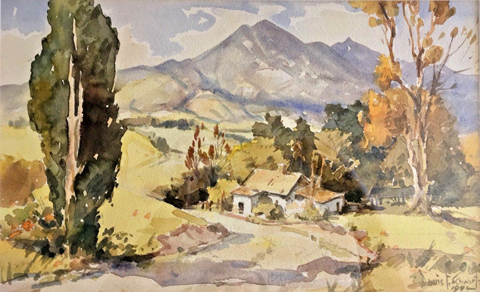
Davis Francis Schwartz, Farmhouse below Mt Tam, 1942 |
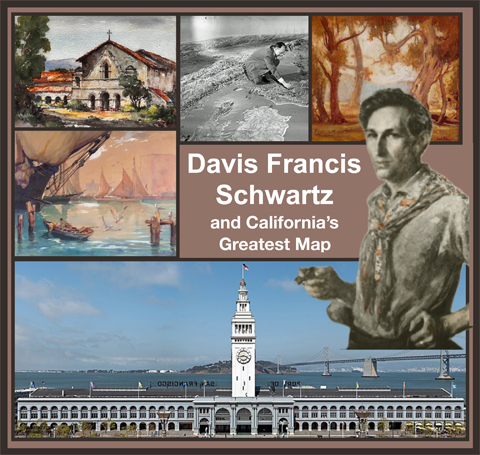 |
Davis Francis Schwartz:
The Artist Behind
California's Greatest Map
by Daniel Rohlfing |
A century ago in the 1920's, San Francisco's Ferry Building stood at the very center of California life.
Long before the Bay Bridge or the Golden Gate Bridge, SF's Ferry Building was the gateway to the West's greatest city. In the 1920's, more than 50,000 commuters poured through the Ferry Building, crossing San Francisco Bay from places as nearby as Oakland and as distant as Sacramento. Each evening those same travelers boarded ferries heading home. If you came to San Francisco during the first quarter of the twentieth century, chances are you arrived through the Ferry Building.
The California State Board of Harbor Commissioners understood that the Ferry Building was more than a transportation hub. It was "California's front door."
The Commissioners wanted visitors to leave with a lasting impression of the state's extraordinary size, beauty. Their idea was to to create an enormous relief map of California portraying the state's diverse geography and vast opportunity.
Filling most of the second floor, stretching nearly six hundred feet in length and eighteen feet in width, and weighing close to seventy tons, the map became the Ferry Building's centerpiece. Known as Paradise in Panorama, this renowned relief map was proclaimed by Scientific American in 1924 to be the largest relief map in the world.
|
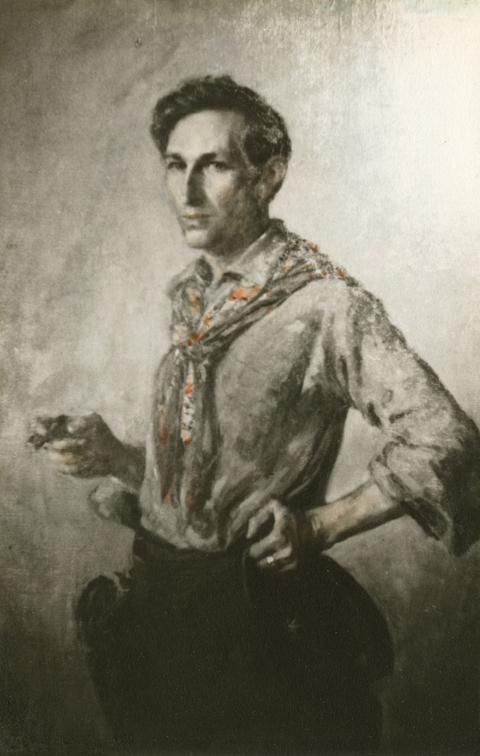
Davis Francis Schwartz, Self Portrait
|
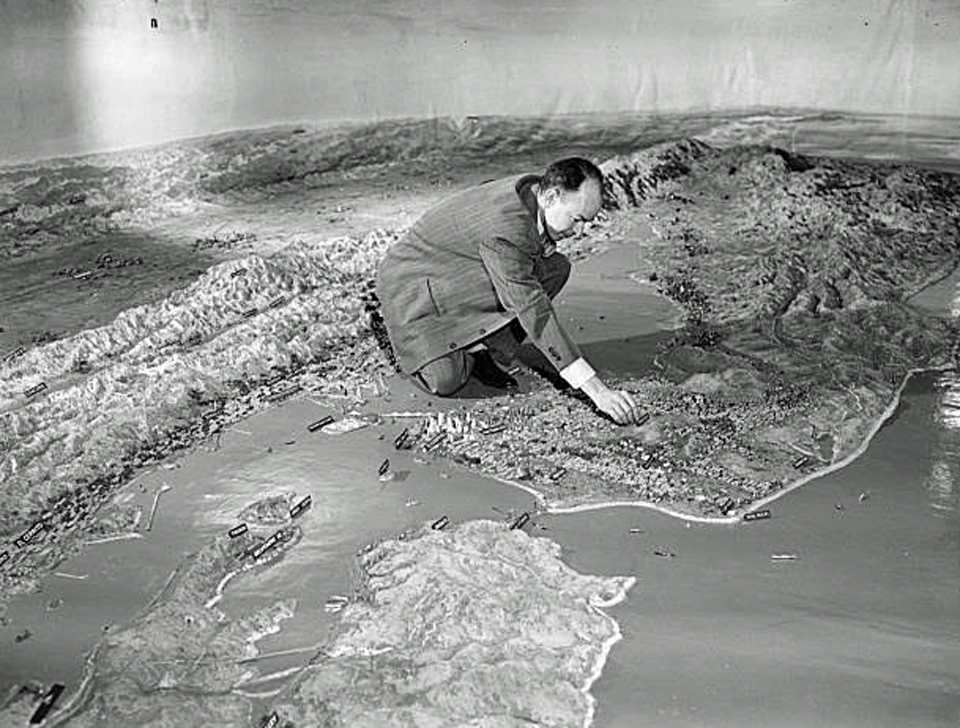
Davis Francis Schwartz making adjustments on the Paradise in Panorama relief map in the Ferry Building |
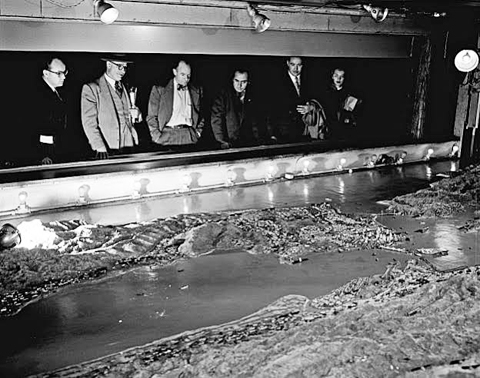
Members of the California State Board of Harbor Commissioners
looking at Paradise in Panorama |
Every masterpiece needs a caretaker, and there was one man uniquely qualified for the job. The State Board of Harbor Commissioners chose an artist who helped design and build Paradise in Panorama, Davis Francis Schwartz. He came to San Francisco in 1924 to oversee the relief map's installation and was hired as the artist in residence to maintain and update the map. This appointment would define the rest of his artistic career.
As part of his compensation, Schwartz was given something every artist dreams of - a spacious studio inside the Ferry Building itself. From this remarkably located studio, he could care for his monumental creation while pursuing a successful career as a California landscape painter. Few artists have ever enjoyed such an extraordinary combination of public service and artistic opportunity.
|
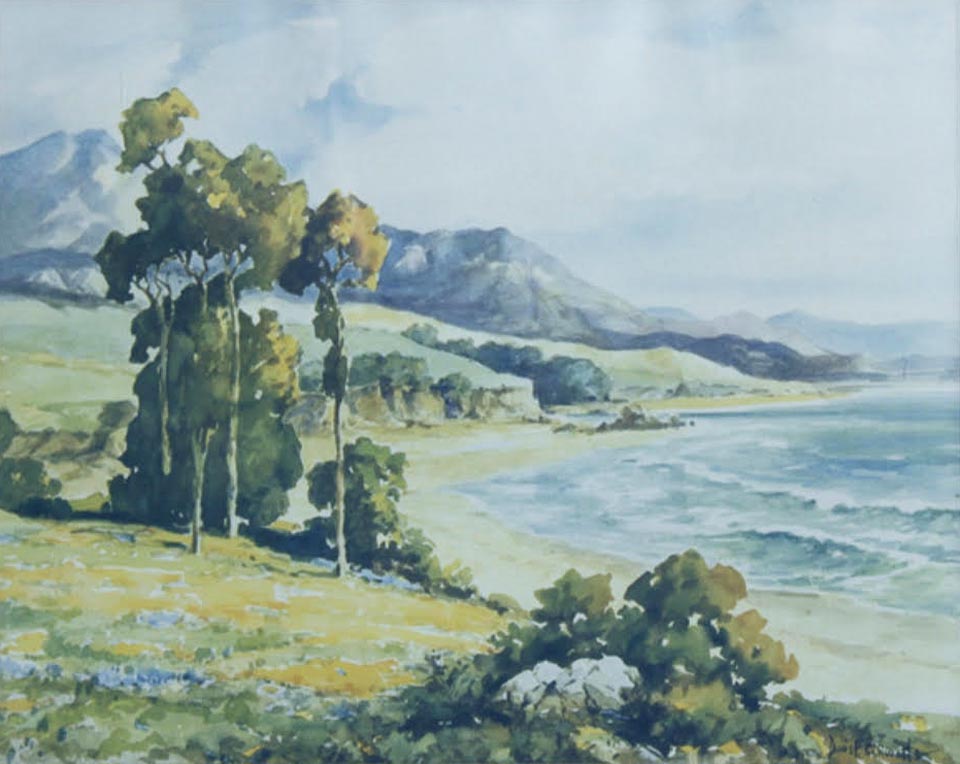
Davis Francis Schwartz, Bayside Hills and Eucalyptus |
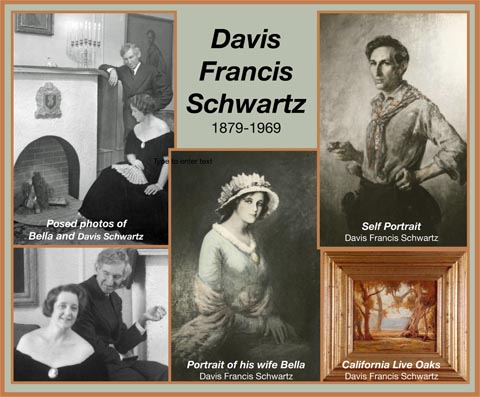
Davis Francis Schwartz was born in 1879 in Paris -- no, not that Paris -- Davis Francis Schwartz was born in Paris, Kentucky. Proud of his Kentucky roots throughout his life, he nevertheless became one of California's devoted welcoming hosts. He studied at the Art Institute of Chicago and continued his education at schools in Dayton and Cleveland, Ohio. After a brief period as an illustrator for the Cleveland Plain Dealer, he headed west in 1903 to begin a new chapter.
California captured his imagination. Soon after arriving in Los Angeles, one of his first purchases was a coal-black pony, which he rode through Pasadena's Arroyo Seco. On New Year's Day 1904, Schwartz and three horse riding friends proudly led the Rose Parade. Around the same time, he secured work as an illustrator for the Los Angeles Times, beginning a long and varied artistic career in California.
|
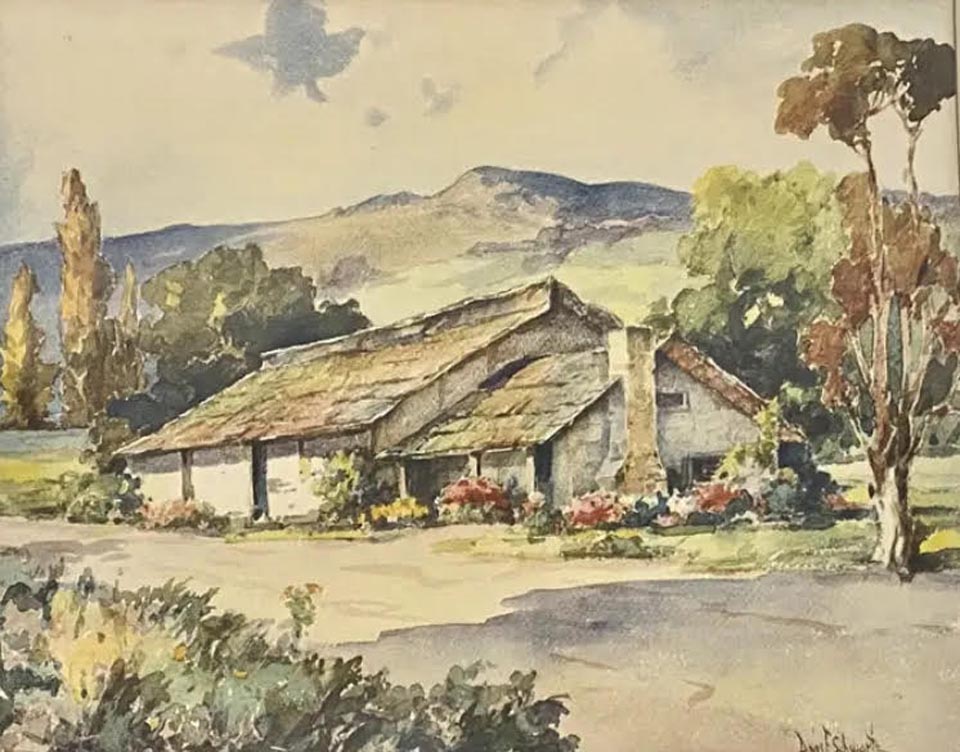
Davis Francis Schwartz
California's first theater, Monterey State Historic Park in downtown, Monterey |
Before leaving Kentucky, Schwartz had dreams of marrying a dark-haired Spanish-California beauty. Fate had something slightly different in mind.
He fell deeply in love with Bella Mellus, a strawberry blonde nearly ten years his junior whose family traced its California roots to early Spanish settlers. After a year-long courtship, they married at St. Vincent's Church in Los Angeles. Their marriage endured for sixty-one years, a remarkable partnership that survived both professional triumphs and profound personal tragedy. They had one son, Stanley, who tragically died in an automobile accident at the age of twenty-two.
In 1909, Schwartz's talents attracted the attention of artist and entrepreneur Gibson Catlett, who recruited him to create elaborate bird's-eye-view paintings promoting new subdivisions. The work took the young couple across North America, with assignments in Los Angeles, Portland, Calgary, Montreal, and Toronto. These years sharpened Schwartz's remarkable ability to translate landscapes into accurate, compelling aerial perspectives—a skill that would later prove invaluable.
After returning briefly to Los Angeles in 1915, the couple spent several years in Chicago before settling permanently in California in 1920. It was then that Schwartz embarked on the project that secured his place in California history.
|
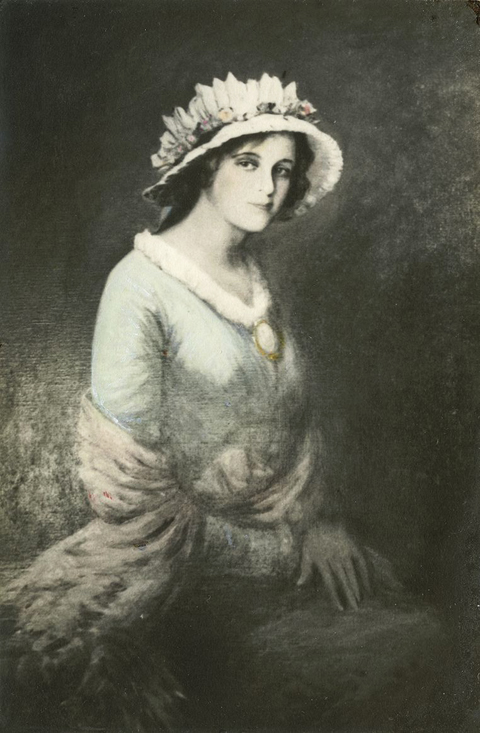
Davis Francis Schwartz
Portrait of Bella Schwartz |
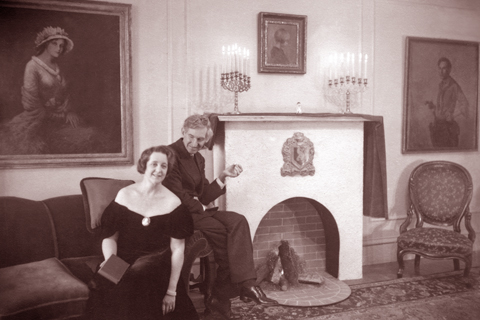 | |
Two photo portraits of Bella and Davis Schwartz at home |
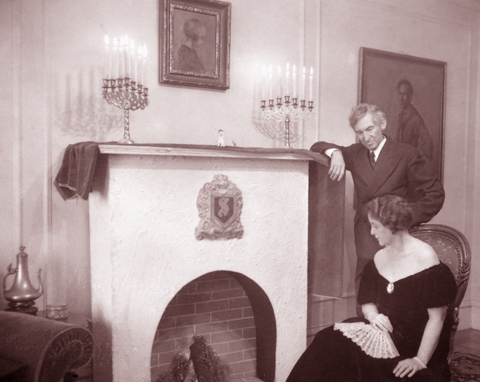 |
Between 1920 and 1924, he designed and helped construct the colossal relief map commissioned by the California State Board of Harbor Commissioners. Combining artistry, engineering, surveying, and cartography, the project was unlike anything attempted before. More than simply a map, Paradise in Panorama became a three-dimensional portrait of California itself. For millions of visitors passing through the Ferry Building over the next three decades, it offered their first grand introduction to the Golden State, graphically imprinting in their minds and hearts California's magnificent Coast, its fertile valleys, the soaring mountains and the vast deserts of the Golden State. |
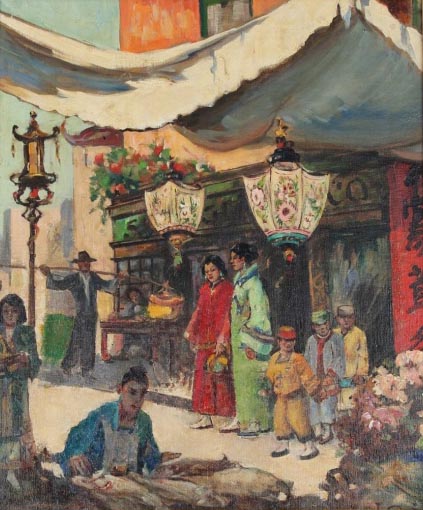
Davis Francis Schwartz, Chinatown San Francisco |
In 1924, Bella and Davis relocated to Berkeley. Each day Davis crossed San Francisco Bay by ferry, one of the thousands of commuters whose daily routine brought them through the very building where he worked. Along with his studio in the Ferry Building, Schwartz also accepted commissions from the California State Chamber of Commerce, whose offices were just down the hall in the Ferry Building. The arrangement placed him at the center of California's business, civic, and artistic communities.
The couple later purchased a beautiful Spanish-style home in the Oakland Hills overlooking San Francisco Bay. But happiness turned to heartbreak on September 16, 1931, when their only son, Stanley, was killed in a tragic automobile accident. It pained them to remain in the family home, so reluctantly, Bella and Davis moved to San Francisco.
In 1940 they found a fresh beginning in Fairfax, Marin County, where they built their dream home among towering trees and a gently flowing creek. One particularly magnificent tree was so cherished by Schwartz that the house was literally designed around it. They affectionately named the property "The Gulch."
|
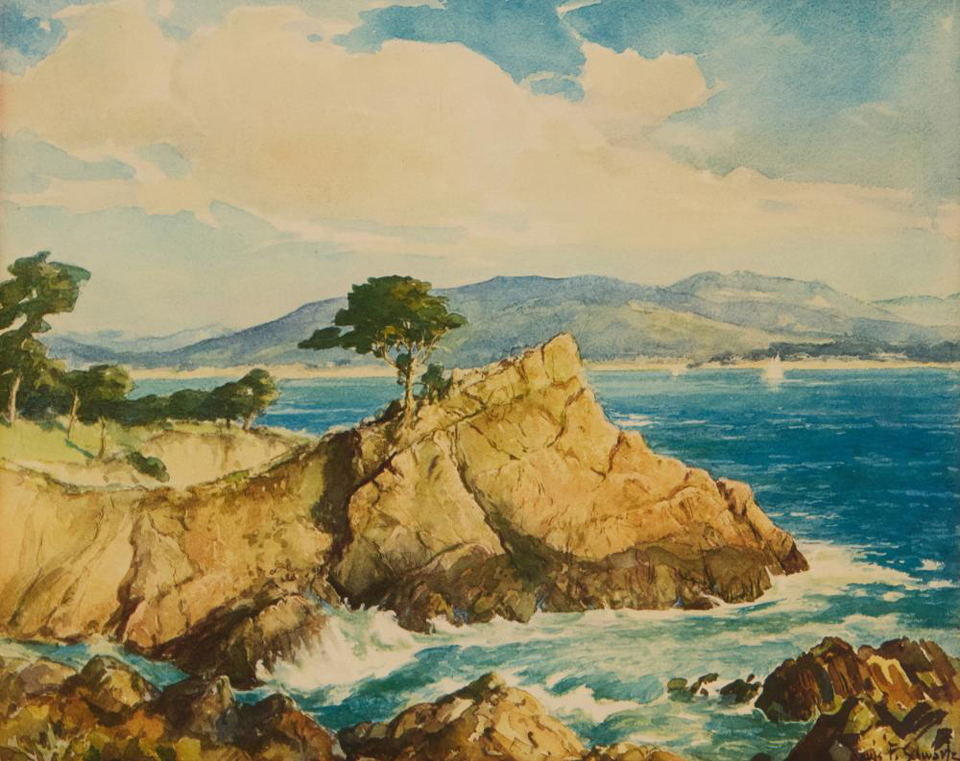
Davis Francis Schwartz, Lone Cypress, Carmel
|
Over the following decades, The Gulch became a gathering place for artists, business leaders, and friends. Bella's legendary cooking along with Davis's storytelling, music, dancing, laughter, and a little good-natured tippling made the Schwartz home famous among its frequent visitors, the so-called "State Chamber Gang." The Davis' hospitality became nearly as legendary as his paintings.
Throughout his career, Schwartz painted the landscapes, coastline, and Spanish missions that define California's visual identity. His canvases are notable for their rich color, poetic atmosphere, and deep affection for the state's varied scenery. He exhibited widely and belonged to organizations including the Carmel Art Association and the Society of Western Artists.
|
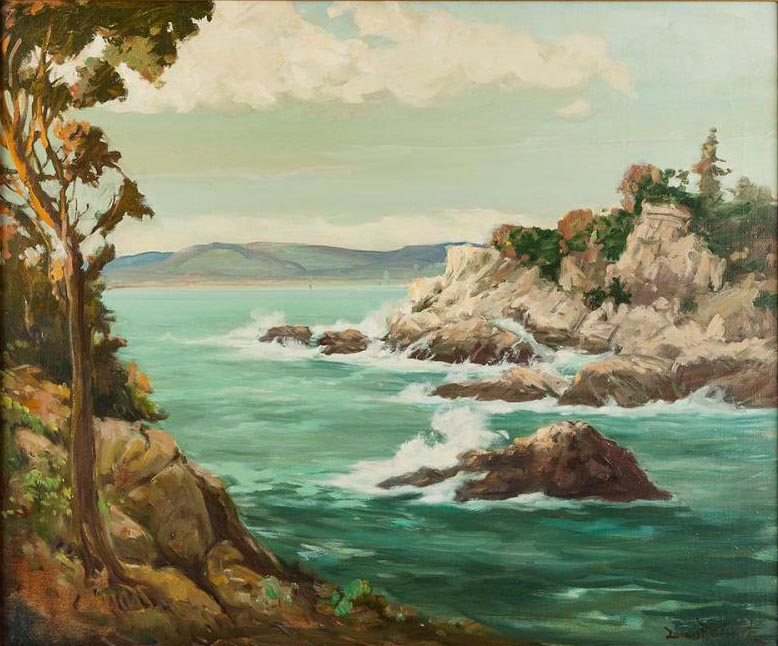
Davis Francis Schwartz
Point Lobos Scene, Carmel |
After the opening of the Golden Gate and Bay Bridges in the early 1930's, the Ferry Building's era as California's transportation hub slowed considerably, and so too did the public prominence of Paradise in Panorama. The map was eventually dismantled, but Schwartz's extraordinary achievement deserves to be remembered. He was more than a gifted landscape painter. He was an illustrator, cartographer, designer, engineer, and one of the few artists whose work enlightened generations of San Francisco commuters, visitors and countless school kids on field trips. |
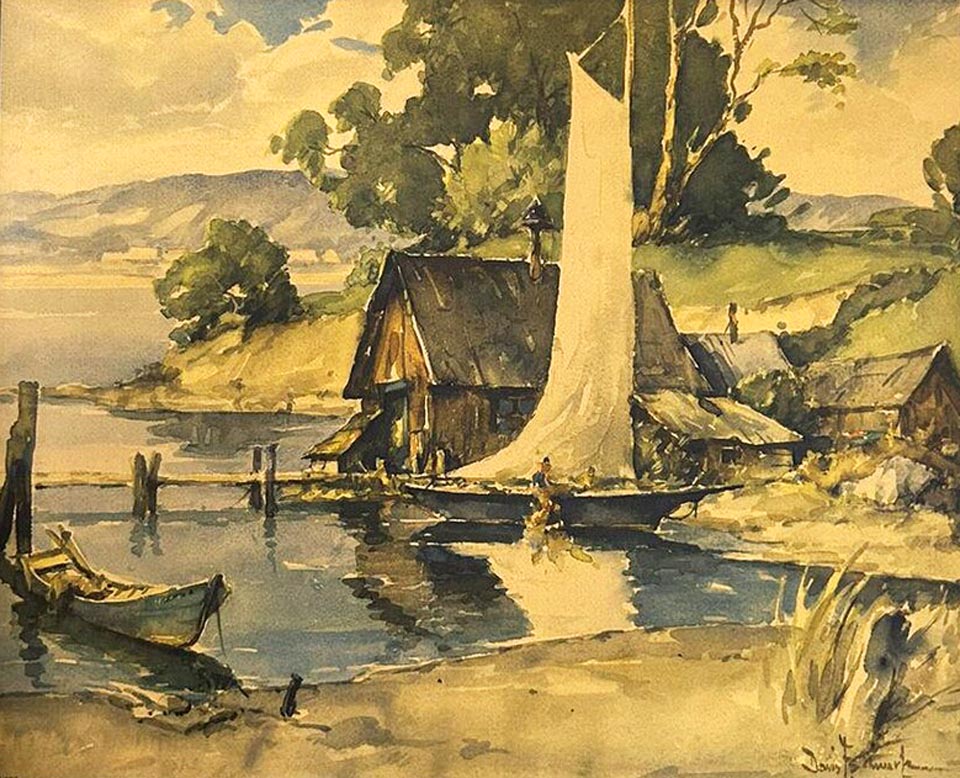
Davis Francis Schwartz, Bayside Shanty and Boats (Possibly China Camp, Marin County) |
Following his retirement, Bella and Davis spent time once again in Southern California before returning to Marin County. Davis Francis Schwartz passed away on New Year's Day, 1969, at the age of 89, closing the life of an artist whose career bridged fine art, public education, and California history.
Today, his paintings continue to delight collectors. Many were made into popular vintage prints for wider distribution at the time, and can often be found today. But perhaps Schwartz's greatest legacy is the one that no longer exists: a monumental map that once inspired generations of Californians and visitors alike to see the Golden State with fresh eyes. Few artists have left such an unusual -- and uniquely Californian -- mark on the history of the state.
|
| Davis Francis Schwartz on our website | NOW at the Gallery |